Reverse Cozen Test: How to Check for Golfer’s Elbow (Medial Epicondylitis)
What Is the Reverse Cozen Test Used For?
The Reverse Cozen Test is a physical examination maneuver that helps clinicians identify medial epicondylitis, better known as golfer’s elbow. It is the mirror image of Cozen’s Test, which screens for lateral epicondylitis (tennis elbow). Where Cozen’s Test loads the wrist extensors on the outside of the elbow, the Reverse Cozen Test loads the wrist flexors that attach on the inside.
Golfer’s elbow is not a frequent or serious disease, but it can cause symptoms that are bothersome in everyday life. The condition also isn’t limited to golfers. It can occur in other athletes whose movements stress the wrist and elbow, and in workers who perform repetitive gripping or lifting.
Understanding Medial Epicondylitis
Medial epicondylitis is a chronic tendinopathic disorder involving the flexor-pronator origin of the medial elbow, with pain and functional limitation related to repetitive loading and microtrauma. Patients typically report medial elbow pain radiating into the forearm and wrist, aggravated by gripping, wrist flexion, or forearm pronation.
Epidemiology shows why accurate testing matters. According to a PubMed-indexed clinical review, the condition affects about 1% of the general population, yet accounts for 3.8% to 8.2% of work-related complaints.
How to Perform the Reverse Cozen Test
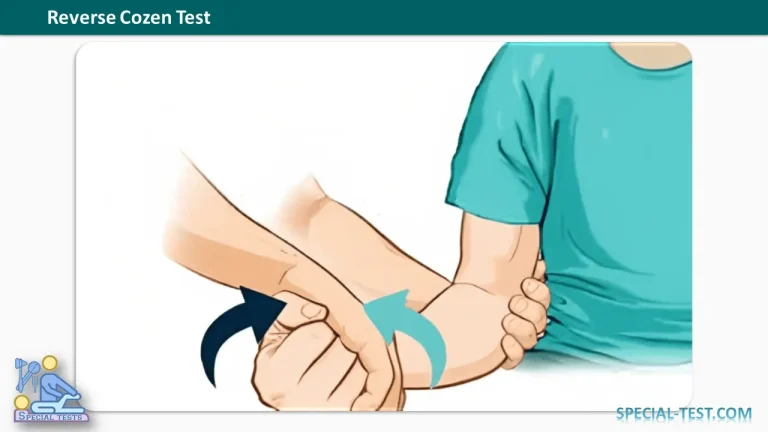
The test is quick and needs no equipment. Follow these steps:
- Position the patient. The patient sits comfortably with the arm supported.
- Palpate the medial epicondyle. With one hand, the examiner feels the bony prominence on the inner side of the elbow.
- Position the forearm and wrist. The examiner’s other hand rests on the wrist of the patient’s supinated forearm (palm facing up).
- Apply resistance. The patient tries to flex the extended hand and wrist while the examiner resists the movement at the wrist.
Stabilize the elbow throughout. Dutton’s Orthopaedic Examination, Evaluation, and Intervention notes this is especially important with this test. If the elbow isn’t held steady, a forceful avoidance movement or pronation could aggravate a compression syndrome in the pronator musculature, known as pronator compartment syndrome.
What Is a Positive Result?
A positive Reverse Cozen Test produces acute, stabbing pain over the medial epicondyle during resisted wrist flexion. This finding suggests medial epicondylitis, because the test loads the flexor-pronator tendon origin that is irritated in this condition.
The examiner should also watch for pain that doesn’t sit directly over the epicondyle, or for symptoms that change when the elbow position changes. These can point to a different problem.
Why a Single Test Is Not Enough
No single maneuver confirms the diagnosis. Reviews describe golfer’s elbow as a clinical diagnosis. One narrative review states that it is primarily based on clinical signs and symptoms and requires a careful physical examination and interview. Another adds that radiographic and imaging studies are mainly needed to distinguish it from other possible causes of medial elbow discomfort.
Differential diagnosis matters because the medial elbow is crowded. A PubMed-indexed review cautions that medial epicondylitis must be distinguished from other medial elbow pathologies, which may exist at the same time. Conditions worth considering include:
- Ulnar collateral ligament injury
- Cubital tunnel syndrome (ulnar nerve irritation)
- Pronator syndrome
- Cervical radiculopathy
When the presentation is atypical, imaging can help. In one narrative review, a sonogram performed by a trained professional had positive and negative predictive values above 90% for diagnosing golfer’s elbow.
What Happens After a Positive Test?
A positive result is a starting point for a full evaluation, not a final diagnosis. Management generally follows a staged approach. One review describes it as a structured, stepwise approach centred on conservative therapy, including rest, physiotherapy, and graduated strengthening programmes. The same review notes that surgery is considered only in chronic, treatment-resistant disease.
This matches earlier literature. A PubMed-indexed clinical review concluded that the large majority of patients with medial epicondylitis respond to a well-structured, nonsurgical program.
Key Takeaways
- The Reverse Cozen Test screens for medial epicondylitis (golfer’s elbow).
- The patient flexes the wrist against resistance while the examiner palpates the medial epicondyle and stabilizes the elbow.
- Sharp, sudden pain over the medial epicondyle is a positive sign.
- Poor stabilization can aggravate pronator compartment syndrome.
- Diagnosis should combine history, several physical tests, and imaging when needed.
References
- Dutton M. Dutton’s Orthopaedic Examination, Evaluation, and Intervention, 3rd ed.
- Ciccotti MC, Schwartz MA, Ciccotti MG. Diagnosis and treatment of medial epicondylitis of the elbow. PubMed: https://pubmed.ncbi.nlm.nih.gov/15474230/
- Medial epicondylitis: evaluation and management. PubMed: https://pubmed.ncbi.nlm.nih.gov/26001427/
- Medial epicondylitis (golfer’s elbow): clinical presentation and treatment. PubMed: https://pubmed.ncbi.nlm.nih.gov/35979571/
- Medial Epicondylitis: A Review of Clinical Presentation, Diagnosis, and Management in the United Kingdom. PubMed: https://pubmed.ncbi.nlm.nih.gov/41742972/
- Ultrasound in the Differential Diagnosis of Medial Epicondylalgia and Medial Elbow Pain. PMC: https://pmc.ncbi.nlm.nih.gov/articles/PMC9407887/