Radiohumeral Joint Distraction Test: Purpose, Technique, and Interpretation
What Is the Radiohumeral Joint Distraction Test Used For?
The Radiohumeral Joint Distraction Test is a clinical special test in the elbow examination. It is used to assess for the presence of loose bodies within the radiohumeral joint, the articulation between the radial head and the capitellum of the humerus. Loose bodies are small fragments of bone or cartilage that float inside the joint. They can cause pain, catching, locking, and a loss of smooth elbow motion. orthofixar
The test is a quick bedside screen that can raise or lower suspicion of a loose body before imaging is ordered. It does not replace imaging or a full clinical evaluation. Orthopedic and physiotherapy resources such as Orthofixar list it alongside other elbow special tests.
Why Loose Bodies in the Elbow Matter
A loose body can become trapped between the joint surfaces during movement, which may cause sudden sharp pain, clicking, or a mechanical block. Common causes include osteochondral injury, osteochondritis dissecans, and degenerative change. Because symptoms often overlap with lateral elbow tendinopathy and other conditions, a structured physical examination helps clinicians narrow the differential diagnosis.
How to Perform the Radiohumeral Joint Distraction Test
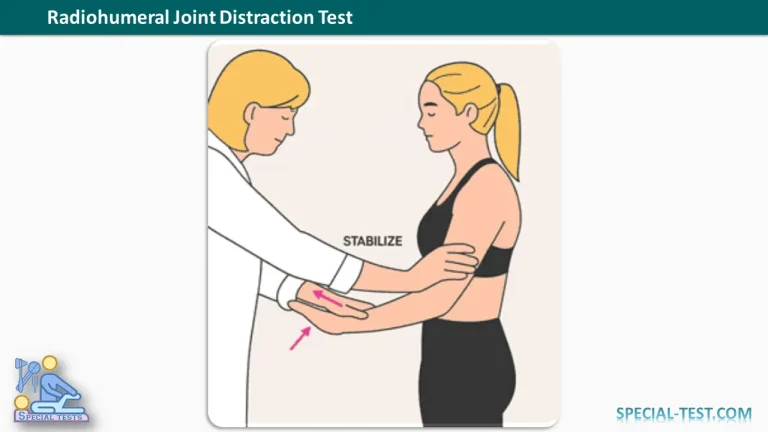
The test compares the patient’s pain during resisted wrist extension with and without traction on the radius. The clinician grasps the distal radius with a lumbrical grip, lets the back of the patient’s hand rest under the clinician’s forearm, and stabilizes the distal humerus with the other hand. researchgate
Step-by-step procedure
- Position: The patient and examiner both stand.
- Grip and stabilization: The examiner grasps the patient’s distal radius with a lumbrical grip. The dorsum of the patient’s hand rests under the examiner’s forearm. The examiner’s other hand stabilizes the distal humerus.
- First contraction (no traction): The patient extends the wrist against the examiner’s forearm with as much resistance as possible. The examiner notes the force generated.
- Pain rating: The examiner asks whether pain was produced and has the patient rate it from 1 to 10.
- Rest: The patient relaxes the contraction.
- Apply traction: The examiner applies and holds a traction force along the line of the radius.
- Second contraction (with traction): While traction is maintained, the patient again extends the wrist against the examiner’s forearm.
- Second pain rating: The examiner again asks about pain and records the intensity.
Matching the effort between the two contractions matters. That is why the examiner monitors the force generated each time, so a change in pain is not simply a change in effort.
What Is a Positive Result?
The test is positive when pain is lower during the second contraction (with traction) than during the first. This pattern suggests a possible loose body in the radiohumeral joint. Distracting the joint may briefly unload the joint surfaces and reduce compression on the fragment, which is why the pain eases.
Clinical Tips and Limitations
- Record both pain scores and the force generated so the result can be compared at follow-up.
- Interpret the result together with history, palpation, range of motion, and other elbow tests.
- A positive test is a prompt for further investigation. Radiographs, CT, or MRI are the usual next steps to confirm a loose body.
- A negative test does not rule out a loose body.
- Peer-reviewed literature on this test can be found by searching PubMed for “radiohumeral (humeroradial) joint distraction test” and “elbow loose body”.
Frequently Asked Questions (FAQ)
What is the Radiohumeral Joint Distraction Test?
It is an elbow special test that screens for loose bodies in the radiohumeral joint by comparing pain during resisted wrist extension with and without traction on the radius.
What does a positive Radiohumeral Joint Distraction Test mean?
A positive test means pain is lower during the second contraction (with traction) than the first. This suggests a possible loose body in the joint.
Can this test diagnose a loose body on its own?
No. It is a screening tool. Imaging such as X-ray, CT, or MRI, along with a full clinical evaluation, is needed to confirm the diagnosis.
Why is traction applied to the radius?
Traction along the line of the radius distracts the joint. This may reduce compression on a loose fragment and change the pain response.
Why does the examiner monitor the force generated?
Pain can change with effort. Tracking force ensures the patient pushes with similar effort in both trials, so any change in pain is more likely due to the traction.
Who should perform this test?
Physicians, orthopedic specialists, and physiotherapists trained in elbow assessment.
What symptoms suggest a loose body in the elbow?
Typical symptoms include pain, clicking, catching, locking, and limited motion. These can overlap with other elbow conditions, so a thorough examination is important.