Moving Valgus Stress Test: Elbow MCL Injury Assessment
What Is the Moving Valgus Stress Test Used For?
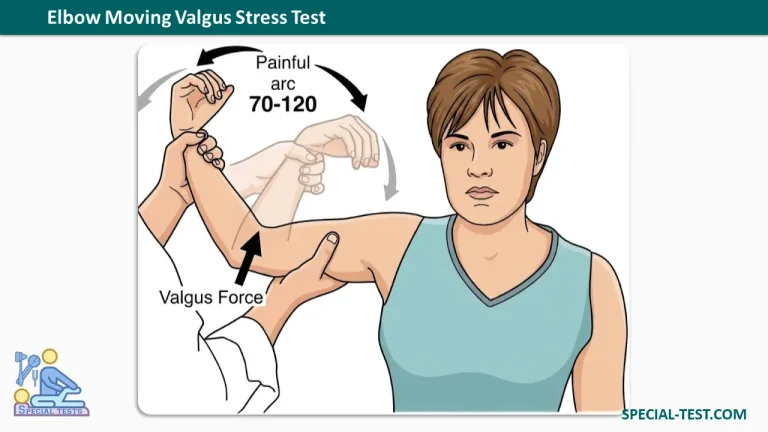
The Moving Valgus Stress Test is a clinical orthopedic exam used to assess medial ulnar collateral ligament (UCL/MCL) injury of the elbow, also known as valgus instability. It is especially useful for evaluating overhead and throwing athletes, such as baseball pitchers, who place repetitive valgus stress on the elbow.
How to Perform the Moving Valgus Stress Test
- Position the patient’s elbow in the same starting position used for the milking maneuver.
- Apply a constant valgus stress to the elbow.
- While maintaining the valgus stress, move the elbow through its full arc of flexion and extension.
What Is a Positive Moving Valgus Stress Test?
The test is positive when the patient experiences apprehension, instability, or pain at the medial collateral ligament origin while the elbow moves between 70° and 120° of flexion. A positive result suggests a medial UCL tear or insufficiency.
Moving Valgus Stress Test Accuracy
| Measure | Value |
|---|---|
| Sensitivity | 100% |
| Specificity | 75% |
The test’s high sensitivity makes it a strong screening tool for ruling out UCL injury when negative. Its moderate specificity means a positive result should be confirmed with further clinical examination or imaging, such as MRI or MR arthrography.
References
- NCBI PubMed Central: Moving Valgus Stress Test study
- Eygendaal, D., & Safran, M. (2006). Postero-medial elbow problems in the adult athlete: Commentary. British Journal of Sports Medicine, 40, 430-434. doi:10.1136/bjsm.2005.025437. View figure on ResearchGate
- Orthofixar: Moving Valgus Stress Test