Golfer’s Elbow Test (Medial Epicondylitis Test)
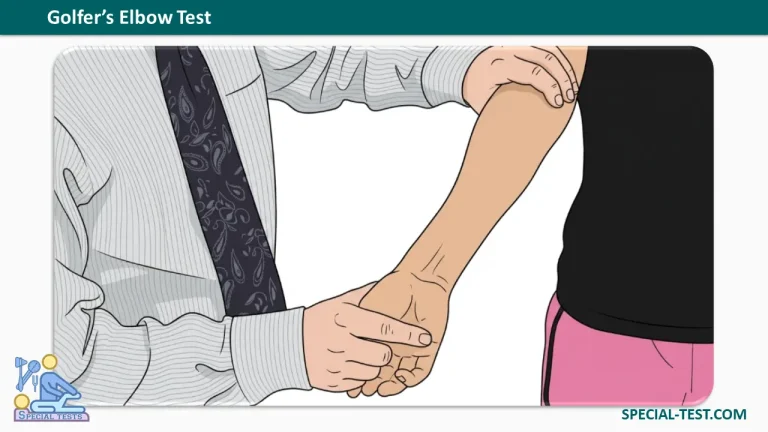
The Golfer’s Elbow Test (also known as the Medial Epicondylitis Test) is a physical examination technique used to evaluate pain and inflammation at the inner elbow. It helps clinicians identify damage or tendinopathy in the common flexor tendon.
What is the Golfer’s Elbow Test Used For?
The Golfer’s Elbow Test is primarily used to diagnose medial epicondylitis (Golfer’s Elbow). This condition is characterized by micro-tearing and overuse inflammation of the forearm flexor-pronator muscle group where it inserts into the medial epicondyle of the humerus.
Although common in golfers, this condition frequently affects non-athletes who perform repetitive wrist flexion or gripping activities.
How to Perform the Golfer’s Elbow Test
The test is performed passively by a examiner to isolate and stress the flexor-pronator origin without muscle active contraction.
Patient Positioning
- The patient can be either comfortably seated or standing.
Step-by-Step Procedure
- Palpation: The examiner palpates the medial epicondyle with one hand while supporting the patient’s elbow.
- Forearm Supination: With the opposite hand, the examiner passively supinates the patient’s forearm.
- Passive Extension: The examiner passively moves the patient’s elbow, wrist, and fingers into full extension.
What is a Positive Golfer’s Elbow Test Result?
A test is considered positive if the patient experiences a sudden onset of pain or discomfort along the medial aspect of the elbow, specifically centered at or near the medial epicondyle.
Clinical Significance: Pain during this passive stretch indicates significant tension on the irritated medial epicondyle and common flexor tendon, confirming medial epicondylitis.
Frequently Asked Questions (FAQ)
What is the difference between Tennis Elbow and Golfer’s Elbow tests?
While the Golfer’s Elbow Test stresses the medial epicondyle using wrist and finger extension, Tennis Elbow tests (like Cozen’s or Mill’s test) stress the lateral epicondyle using wrist extension against resistance or wrist flexion stretches.
How sensitive is the Golfer’s Elbow Test?
While helpful in physical examination, the test is best combined with clinical history and active resistance tests (such as resisted wrist flexion and forearm pronation) for higher diagnostic accuracy.
References
- Dutton, M. (2012). Dutton’s Orthopaedic Examination, Evaluation, and Intervention (3rd ed.). McGraw-Hill Education.