Bicipital Aponeurosis Flex Test: Procedure & Results
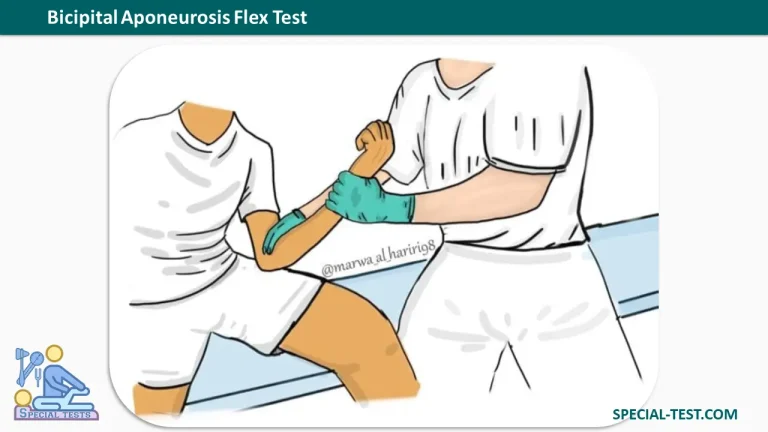
The Bicipital Aponeurosis Flex Test (also known as the Lacertus Fibrosus Test) is a specialized orthopedic physical examination used to assess the structural integrity of the bicipital aponeurosis.
Purpose of the Test
This test is primary performed to detect a complete distal biceps tendon rupture. Evaluating the bicipital aponeurosis helps clinicians determine the degree of retraction in the biceps muscle belly and distinguish between complete and partial tears.
How to Perform the Bicipital Aponeurosis Flex Test
- Patient Positioning: Have the patient make a tight fist and actively flex their wrist while keeping the forearm in a fully supinated position.
- Elbow Flexion: Maintaining the flexed wrist and fist, instruct the patient to flex the elbow and hold it at 75 degrees of flexion.
- Palpation: The examiner palpates the medial aspect of the antecubital fossa to feel for the sharp, tense edge of the bicipital aponeurosis.
Diagnostic Findings & Results
- Positive Result: The absence of a palpable, sharp, thin edge of the aponeurosis along the medial side of the antecubital fossa. This absence indicates a disruption or tear of the lacertus fibrosus associated with a distal biceps tendon rupture.
- Negative Result: A distinct, taut, cord-like or sharp edge is clearly palpable under tension on the medial aspect of the cubital fossa.
Diagnostic Accuracy & Test Reliability
According to clinical studies (e.g., ElMaraghy et al.), the Bicipital Aponeurosis Flex Test demonstrates high diagnostic reliability:
| Metric | Value |
| Sensitivity | 100% |
| Specificity | 90% |
| Overall Accuracy | 94% |
Clinical References
- ElMaraghy A, Devereaux M. The “bicipital aponeurosis flex test”: evaluating the integrity of the bicipital aponeurosis and its implications for treatment of distal biceps tendon ruptures. J Shoulder Elbow Surg. 2013.
- Cleland J, Koppenhaver S, Su J. Netter’s Orthopaedic Clinical Examination: An Evidence-Based Approach. 3rd ed. Elsevier.