Published September 9, 2026Read time 1 min readReaders 51
What is the “Dynamic Rotary Stability Test (DRST)” used for?
Assesses the rotator cuff’s ability to maintain the humeral head in the glenoid through the arc of rotation (i.e., the ability of the rotator cuff to maintain arthrokinematic control)
How to perform the “Dynamic Rotary Stability Test (DRST)”?
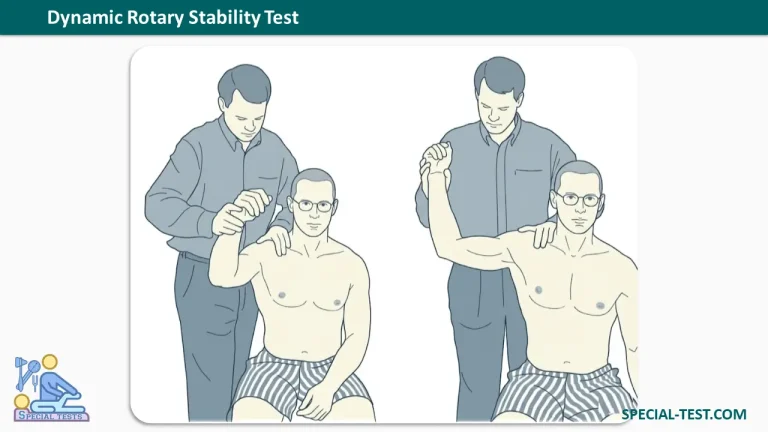
The patient is positioned in sitting or lying with the arm abducted to about 90° and the elbow flexed to about 90°.
The examiner controls the patient’s arm position with one hand while the other hand palpates the position of the humerus in the glenoid (it is best to palpate the joint line)
The examiner places the patient’s glenohumeral joint in different positions of flexion and abduction close to the position where the patient has symptoms.
The patient is asked to do an isometric contraction against light to moderate resistance and then isotonically (concentrically or eccentrically [eccentric break] depending on what movements caused the patient’s symptoms).
While the patient does the contraction, the examiner palpates the joint line to see if and when arthrokinematic control is lost (i.e., does the humeral head slip or translate?).
What is the positive result?
During the test, the scapula should be stable and should not translate.
If the scapula protracts during the test, it indicates lack of scapular control.