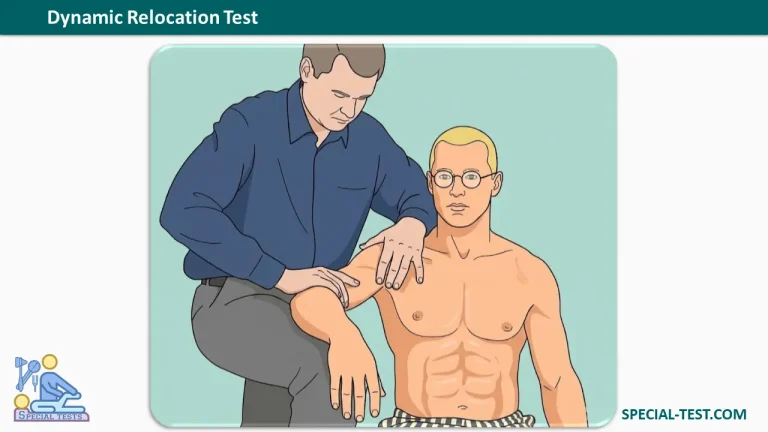
Dynamic Relocation Test
What is the “Dynamic Relocation Test” used for?
- Dynamic Relocation Test tests the ability of the rotator cuff to stabilize the humeral head through cocontraction of the rotator cuff muscles.
How to perform the “Dynamic Relocation Test”?
- The patient is seated with the arm supported in 60° to 80° abduction in the scapular plane (scaption)
- With the middle finger of one hand palpating the subscapularis and the thumb along the outer edge of the acromion, the examiner uses the other hand to apply traction (longitudinal distraction) to the arm while asking the patient to pull the arm up into the socket.
What is the positive result?
- As the patient pulls the arm in and up, the examiner should feel for contraction of the rotator cuff, especially the subscapularis.
- If the pectoral muscles are overactive, the examiner may palpate the rotator cuff posteriorly.
- During the test, the scapula should not move. If the scapula protracts, it indicates an unstable scapula.