Dizziness Test
Used For
- Identify whether dizziness is caused by issues in vertebral arteries or semicircular canals of the inner ear.
How to Perform
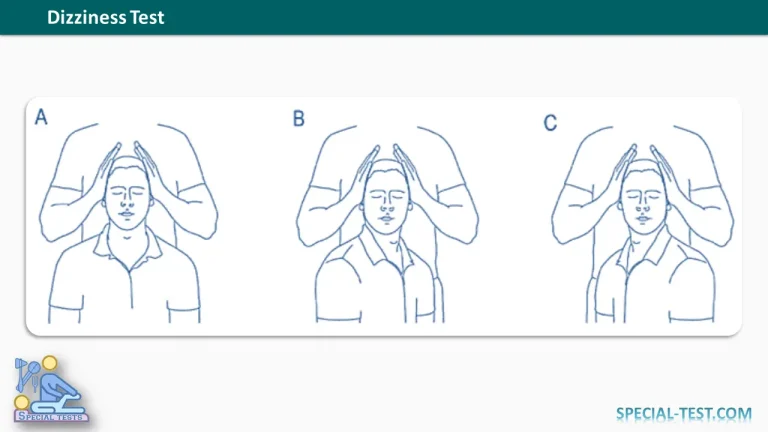
- The patient sits, and the examiner grasps the patient’s head. The examiner actively rotates the patient’s head as far as possible to the right and then to the left, holding the head at the extreme of motion for a short time (10 to 30 seconds) while the shoulders remain stationary. The patient’s head is then returned to neutral.
- Next, the patient’s shoulders are actively rotated as far to the right as possible, held for 10 to 30 seconds, and then to the left as far as possible, and held for 10 to 30 seconds while keeping the head facing straight ahead.
Result
- If the patient experiences dizziness in both cases, the problem lies in the vertebral arteries, because in both cases the vertebral artery may be “kinked,” decreasing the blood flow.
- If the patient experiences dizziness only when the head is rotated, the problem lies within the semicircular canals of the inner ear.