Crossed Extension Reflex
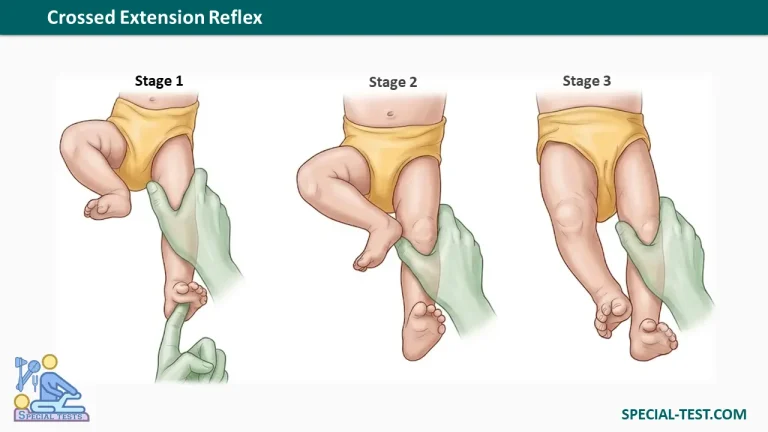
What is the "Crossed Extension Reflex" used for?
The crossed extension reflex, also known as Philippson reflex, is present at birth and normally disappears by 1 to 2 months of age:
- If it is absent at birth, the neonate may have flaccid paralysis.
- Its presence beyond 2 months of age is indicative of a partial or incomplete spinal lesion or neurologic dysfunction.
How to perform the "Crossed Extension Reflex"?
- The infant is placed supine with the lower limbs in midline and the hips and knees extended.
- The reflex is elicited by holding one lower limb in extension at the knee and applying firm pressure by rubbing or stroking the sole.
What is the positive result?
- The opposite, free hip will initially flex and abduct, then adduct and extend, as if the infant were trying to push away from the stimulus.
- There may be associated fanning of the toes of the stimulated leg.
- Stimulation of the sole of the foot causes flexion of the ipsilateral limb, moving it away from the stimulus, and extension of the contralateral limb, moving it toward the stimulus.
- In neonates, a similar response can be elicited by applying strong pressure in the inguinal region, which causes flexion of the ipsilateral limb and extension of the contralateral hip and knee.