Bowstring Test
What is the "Bowstring Test" used for?
- Sciatic nerve tension or irritation
How to perform the "Bowstring Test"?
Supine Version
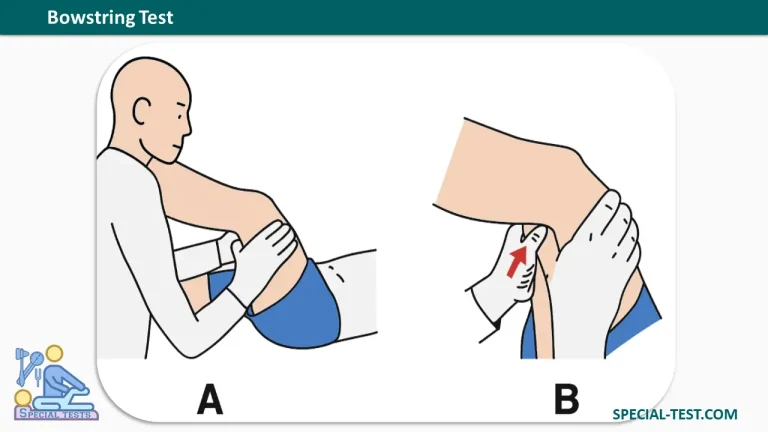
- The examiner performs a Straight Leg Raise (SLR) on the affected side until the patient reports pain or radicular symptoms radiating down the leg (Fig. 9.51).
- Without changing the position of the thigh, the examiner slightly flexes the knee—about 20 degrees—which usually reduces the symptoms.
- The examiner then applies firm pressure with the thumb or fingers over the popliteal fossa (where the sciatic nerve runs).
- Reproduction of the patient’s pain or paresthesia constitutes a positive Bowstring Test.
Seated Position (Sciatic Tension Test/Deyerle's Sign)
- The patient sits on the edge of the examination table with knees flexed. The examiner passively extends the patient's knee, producing pain through sciatic nerve tension.
- The examiner slightly flexes the knee until the pain and radicular symptoms disappear. The examiner maintains this position by clasping the patient's leg between their own knees, stabilizing the limb.
- With the leg stabilized, the examiner presses the fingers of both hands deeply into the popliteal space. Pain resulting from this maneuver indicates a positive test.
What is the positive result?
Reproduction of the patient’s pain or paresthesia constitutes a positive Bowstring Test.
This finding suggests:
- Nerve root compression (commonly from disc herniation at L4-L5 or L5-S1 levels) .
- Sciatic nerve irritation or inflammation .
- True radiculopathy rather than muscular or non-neurogenic pain.