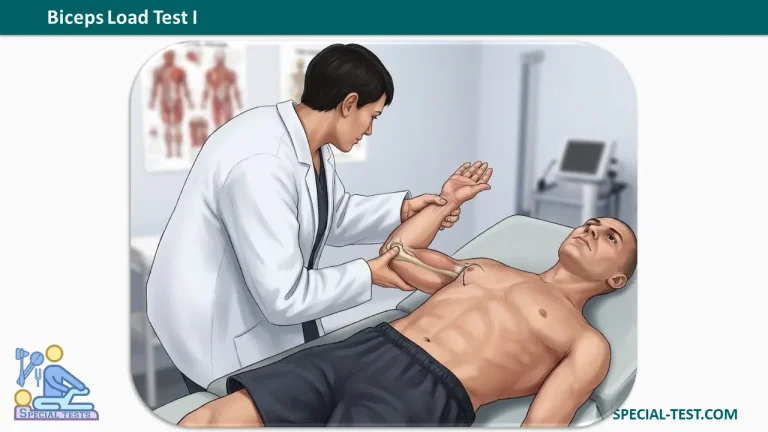
Biceps Load Test I
What is the "Biceps Load Test I" used for?
- Biceps Load Test I is used to diagnosis of superior labral tears in patients who have anterior shoulder instability associated with Bankart lesions.
How to perform the "Biceps Load Test I"?
- The patient is placed supine with the arm abducted to 90 degrees.
- The elbow is flexed 90° and the arm is placed in a neutral rotation.
- The forearm is supinated and then an anterior apprehension maneuver is performed (external rotation of the arm). If a feeling of instability or anterior shoulder pain occurs, external rotation is stopped.
- The patient is then asked to actively flex the forearm at the elbow against resistance by bringing the hand toward the face.
- During this maneuver, the patient is asked whether the feeling of instability is improved, unchanged, or worsened.
What is the positive result?
- If the pain and feeling of instability improve, there is no indication of a SLAP lesion.
- If the symptoms are unimproved or even worsened, then there is suspicion of a SLAP lesion.
- The examiner should note that the forearm should be supinated during the test. Also, the examiner should be at the same level as the patient.
Test Accuracy
- Sensitivity: 90.9 %
- Specificity: 96.9 %
References
- Clinical Tests for the Musculoskeletal System 3rd Edition.
- Tennent, Duncan & Beach, William & Meyers, John. (2003). Clinical Sports Medicine Update. A Review of the Special Tests Associated with Shoulder Examination Part II: Laxity, Instability, and Superior Labral Anterior and Posterior (SLAP) Lesions. The American journal of sports medicine. 31. 301-7. 10.1177/03635465030310022601.