Anterior Release Test
What is the “Anterior Release Test” used for?
- Anterior instability of the shoulder that depends on the apprehension feeling.
- It’s also called surprise test.
How to perform the “Anterior Release Test”?
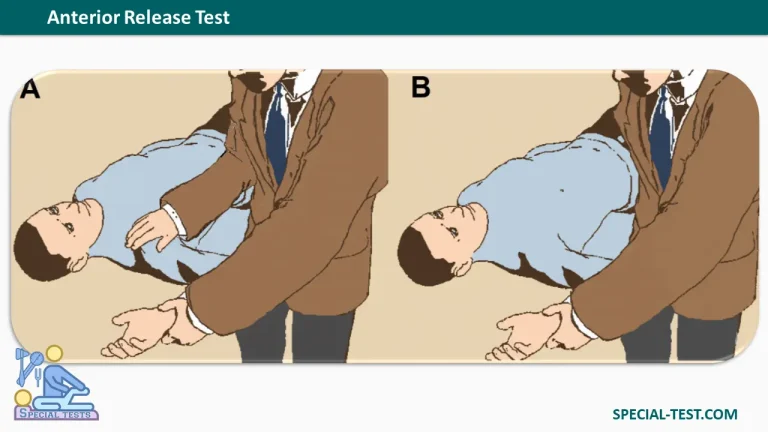
- The patient lies in the supine position with the shoulder at 90 degrees of abduction and the elbow flexed to 90 degrees.
- The clinician passively moves the patient’s shoulder into external rotation while applying a posteriorly directed force to the head of the humerus.
- At the point of end-range external rotation, the clinician quickly releases the posterior force and notes whether the patient displays any sign of apprehension.
What is the positive result?
- The resulting pain from this shoulder anterior release test procedure may be caused by anterior shoulder instability, a labral lesion (Bankart lesion or SLAP lesion – superior labrum, anterior posterior), or bicipital peritenonitis or tendinosus.
- Most commonly it is related to anterior instability because the pain is temporarily produced by the anterior translation.
- It has also been reported to cause pain in older patients with rotator cuff pathology and no instability.
Test Accuracy
- Sensitivity: 63.89%
- Specificity: 98.91%.
References
- Gross ML, Distefano MC. Anterior release test. A new test for occult shoulder instability. Clin Orthop Relat Res. 1997 Jun;(339):105-8. doi: 10.1097/00003086-199706000-00014. PMID: 9186207.