Allen Test
What is the "Allen Test" used for?
- The Allen test (or as it called Fist-Closure Test) is used to determine the patency of the vessels supplying the hand (the radial and ulnar arteries).
How to perform the "Allen Test"?
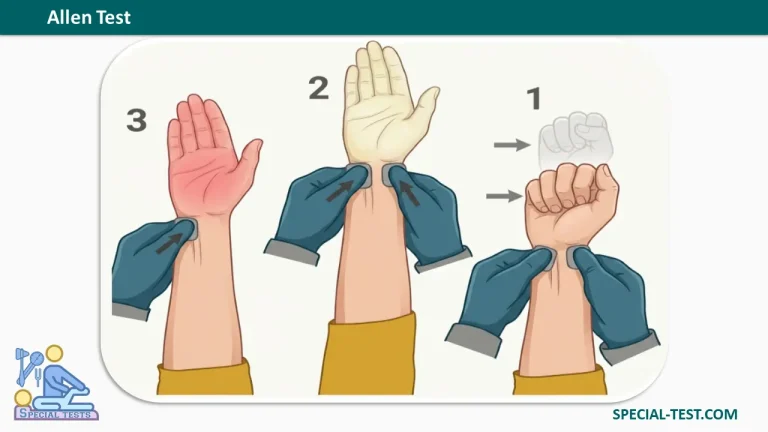
- The patient is seated with the elbow flexed and forearm supinated, and raises his or her arm above the horizontal plane.
- The examiner grasps the patient’s wrist and applies finger pressure to block the vascular supply from the radial and ulnar arteries.
- The patient then makes a fist three to four times so as to force the venous blood out of the hand via the posterior veins.
- After 1 minute, the patient lets the arm hang down and opens the now pale hand.
- The examiner now releases compression, first from one artery then from the other.
- This procedure is repeated with the radial artery released and compression on the ulnar artery maintained.
What is the positive result?
- Normal filling time is usually less than 5 seconds ( Rapid, uniform reddening of the hand in the areas supplied by the respective arteries).
- If the return of color to the palm is significantly prolonged after the release of either artery, the examiner should conclude that perfusion from that artery is reduced ( positive Allen Test ).
Test Accuracy
- Sensitivity: 73.2%
- Specificity: 97.1%
References
- Clinical Tests for the Musculoskeletal System 3rd Edition.
- Dutton’s Orthopaedic Examination, Evaluation, And Intervention 3rd Edition.