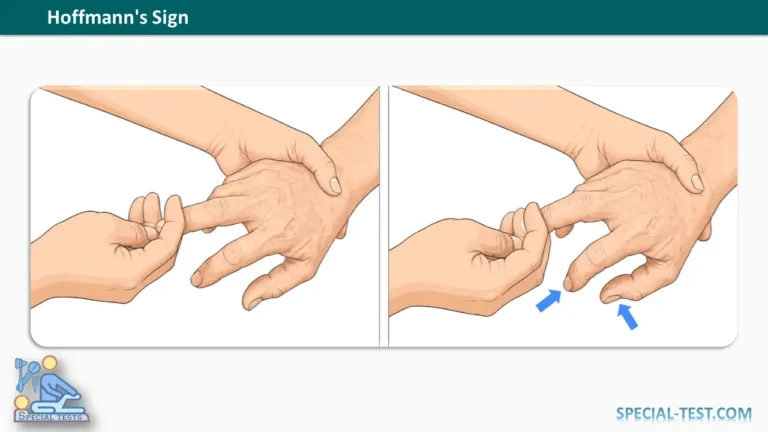
Hoffmann’s Sign
What is the Hoffmann’s Sign Used For?
- It is a neurological reflex test used to detect upper motor neuron lesions and corticospinal tract dysfunction
How to Perform the Hoffmann’s Sign?
- Position the subject’s relaxed hand ensuring dorsiflexion at the wrist and partial flexion of the fingers.
- Hold the subject’s partially extended middle finger between your index and middle finger, ensuring you stabilize the proximal IP joint.
- Perform a sharp and forceful flick of your thumb, making contact with the nail of the subject’s middle finger.
- The subject’s finger will flex immediately followed by relaxation.
Test Result
- The presence of Hoffmann’s sign is characterized by flexion and adduction of the thumb and flexion of the index finger.
- A positive Hoffmann’s sign is suggestive of corticospinal tract dysfunction localized to the cervical segments of the spinal cord.
- Negative result: The thumb and index finger do not move or stay still.
What a Positive Result Means
- Upper motor neuron problem: It shows an overactive reflex (hyperreflexia) caused by damage to the central nervous system pathways that normally control and calm down reflexes.
- Common causes: Cervical myelopathy (compressed spinal cord in the neck from arthritis or disc issues), multiple sclerosis, or other brain and spinal cord conditions.
- False positives: Up to 3% of healthy people without any nerve disease can test positive, meaning the test alone does not confirm a diagnosis and requires further imaging like an MRI.