Slocum Test
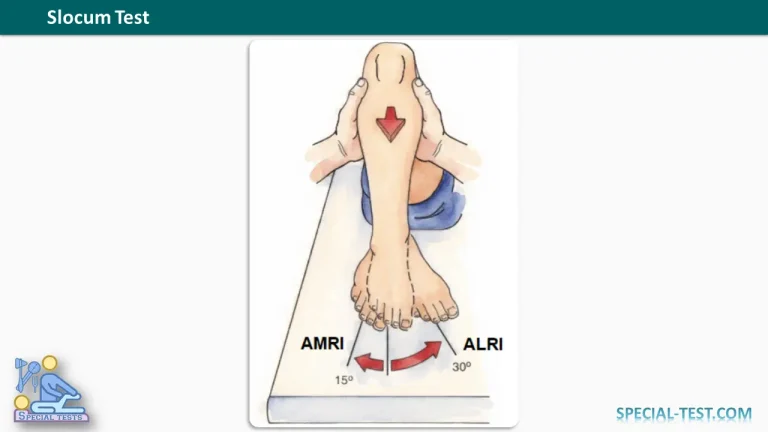
What is the "Slocum Test" used for?
- Anterior rotary instability of the knee,
- Differentiating between anterolateral rotary instability (ALRI) and anteromedial rotary instability (AMRI).
How to perform the "Slocum Test"?
The patient lies supine with the knee is flexed to 80–90 degrees and the hip is flexed to approximately 45 degrees while the examiner stabilizes the foot by sitting on the forefoot.
Slocum Test for Anterolateral Rotary Instability (ALRI):
- Position the foot in 30 degrees of medial (internal) rotation and stabilize the foot firmly then apply an anterior force to the proximal tibia.
- The test is positive when excessive anterior movement occurs primarily on the lateral side of the knee. Movement is increased compared to the contralateral, uninjured knee.
A positive ALRI suggests injury to one or more of the following:
- Anterior cruciate ligament (ACL)
- Posterolateral capsule
- Arcuate–popliteus complex
- Lateral collateral ligament (LCL)
- Posterior cruciate ligament (PCL)
- Iliotibial band (IT band)
Slocum Test for Anteromedial Rotary Instability (AMRI)
- This is also known as Lemaire’s T Drawer Test: Position the foot in 15 degrees of lateral (external) rotation and apply an anterior force to the tibia.
- The test is positive when excessive anterior movement occurs primarily on the medial side of the knee. Movement is greater than on the unaffected side.
A positive AMRI indicates possible injury to:
- Medial collateral ligament (MCL): Particularly the superficial fibers
- Posterior oblique ligament
- Posteromedial capsule
- Anterior cruciate ligament (ACL)