Seated Piriformis Stretch Test
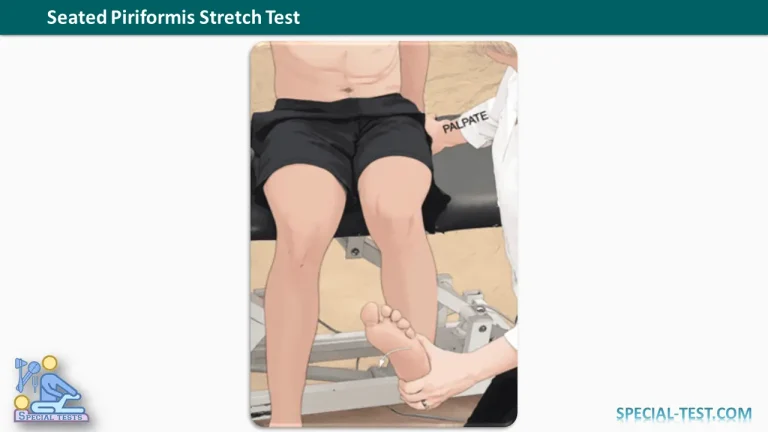
What is the "Seated Piriformis Stretch Test" used for?
- Assess irritation, tightness, or pathology involving the piriformis muscle and its relationship to the sciatic nerve.
How to perform the "Seated Piriformis Stretch Test"?
- The patient sits upright at the edge of the examination table. Hips and knees are flexed to approximately 90°.
- The examiner extends the patient’s knee to place a gentle stretch on the sciatic nerve.
- While maintaining knee extension, the examiner passively flexes the hip further and moves it into adduction, and medial (internal) rotation.
- The examiner palpates the piriformis muscle: Laterally to the ischial tuberosity, or Proximally at the sciatic notch. These are common locations where the piriformis may compress or irritate the sciatic nerve.
What is the positive result?
Reproduction of the patient’s familiar pain in the region of the piriformis. Pain may radiate along the posterior thigh if the sciatic nerve is involved.
A positive test supports suspicion of:
- Piriformis syndrome
- Deep gluteal syndrome
- Myofascial involvement of the deep hip rotators.
Test Accuracy
- Sensitivity: 52%
- Specificity: 90%