Prone Bridge Test
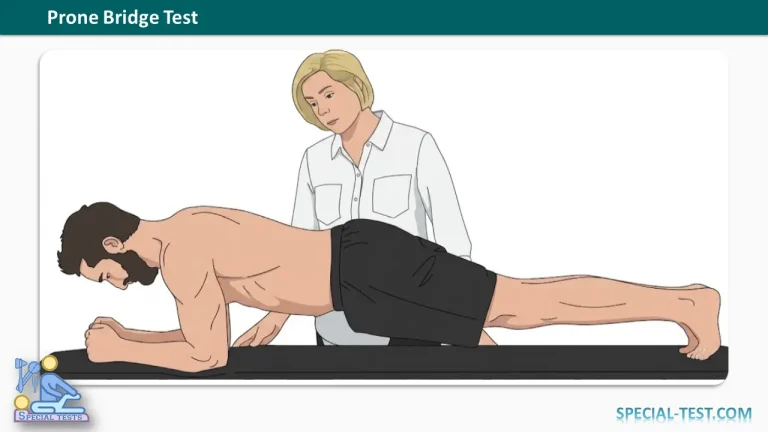
What is the "Prone Bridge Test" used for?
- Evaluate the endurance of the core musculature, specifically the abdominal and back extensor muscles, as well as the patient’s ability to maintain trunk stability under static conditions.
How to perform the "Prone Bridge Test"?
- The patient lies in a prone position on the examination table or mat.
- They are instructed to assume the elbow push-up position, with elbows placed directly under the shoulders, forearms resting on the ground, feet together, and hands shoulder-width apart.
- The patient lifts their body off the surface, forming a straight line (plank) from the shoulders through the hips to the feet.
- The neck should remain neutral, and the gaze directed toward the floor.
- The patient is asked to hold this position for as long as possible while maintaining proper alignment and control.
What is the positive result?
Standard Hold Time: A minimum of 90 seconds is considered the baseline for adequate core endurance.
Normal Values: Research indicates that healthy individuals typically achieve hold times of 145 ± 71.5 seconds (mean ± standard deviation), suggesting considerable variability in normal populations.
Performance Categories:
- Excellent: >180 seconds
- Good: 120-180 seconds
- Average: 90-120 seconds
- Below Average: 60-90 seconds
- Poor: <60 seconds