Bechterew Test
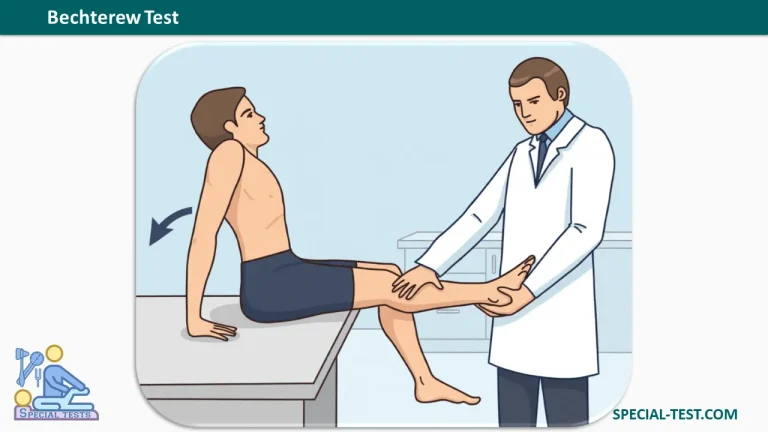
What is the "Bechterew Test" used for?
- Also known as the Sitting Straight Leg Raise Test
- Assesses nerve root irritation and sciatica in seated patients.
- It's similar to the slump test.
How to perform the "Bechterew Test"?
The patient sits comfortably on the examination table with both feet flat on the floor, thighs fully supported by the table edge, and hands resting on the table for stability.
- Phase 1: Uninvolved Leg Testing The patient is instructed to actively extend the uninvolved (asymptomatic) leg at the knee, maintaining this position briefly before returning the foot to the floor.
- Phase 2: Involved Leg Testing The patient then extends the involved (symptomatic) leg at the knee. The examiner observes for any reproduction of symptoms, compensatory movements, or inability to achieve full extension.
- Phase 3: Bilateral Extension If no symptoms are produced during single-leg testing, the patient is asked to extend both legs simultaneously at the knee, which increases the overall neural tension and may elicit subtle findings not apparent during unilateral testing.
What is the positive result?
A positive finding includes:
- The reproduction of radicular pain below the knee,
- inability to attain full knee extension,
- leaning backward and bracing oneself on the table (tripod sign)