Derby Relocation Test
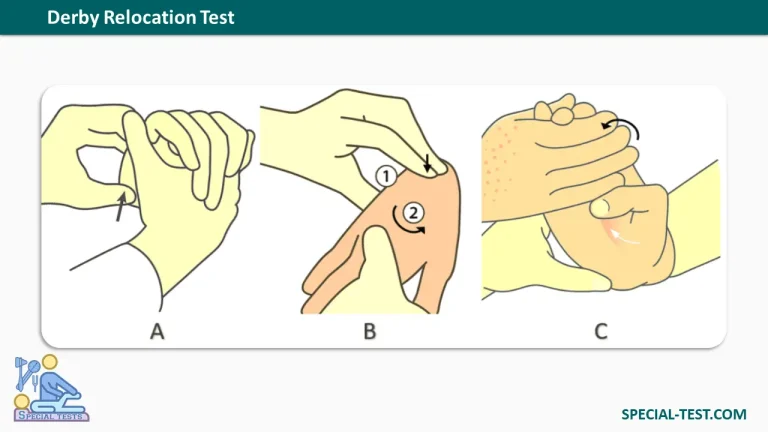
What is the "Derby Relocation Test" used for?
- Assesses the integrity of the lunotriquetral interval
- Assesses for peritriquetral and triquetrolunate injuries.
How to perform the "Derby Relocation Test"?
The patient is first asked “does the wrist feel unstable or loose?” (i.e., the question). This is then followed by three tests.
- One, the patient is seated with the arm resting on a table and elbow flexed to 90° and the wrist pronated, extended and radially deviated. The examiner places a thumb on the anterior aspect of the patient’s pisiform and applies a posteriorly directed force while bringing the patient’s wrist into neutral. In this position, a positive response is resolution of the subjective instability and improvement and/or grip strength can be maintained longer.
- For Test Two, the examiner then moves the patient’s wrist until the patient’s subjective feeling of wrist instability returns and the wrist is then pronated, radially deviated and in neutral flexion. The examiner then applies a posterior to anterior directed force to the dorsum of the patient’s triquetrum while ulnarly deviating the patient’s wrist. A positive test is pain with the wrist in ulnar deviation.
- For Test Three, the examiner moves the wrist until the subjective instability returns. The wrist is again pronated, radially deviated and in neutral flexion. The examiner places his or her thumb onto the anterior aspect of the patient’s pisiform and applies a posteriorly directed force while ulnarly deviating the patient’s wrist. A positive test is less pain with the wrist ulnar deviation than was experienced in test two.