Feiss Line Test
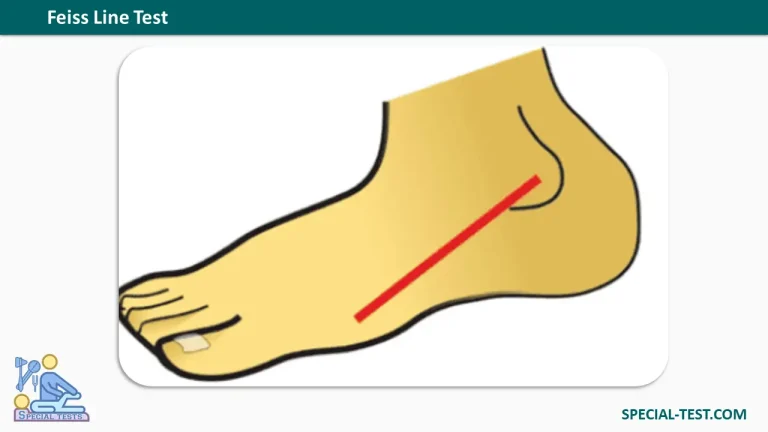
What is the "Feiss Line Test" used for?
- The Feiss line test is used to assess the height of the medial arch, using the navicular position
How to perform the "Feiss Line Test"?
- With the patient non–weight-bearing, the clinician marks the apex of the medial malleolus and the plantar aspect of the first MTP joint, and a line is drawn between the two points the so called (Feiss Line).
- The navicular is palpated on the medial aspect of the foot, and an assessment is made of the position of the navicular relative to the imaginary Feiss line.
- The patient is then asked to stand with their feet approximately 3–6 inches apart.
What is the positive result?
In weight-bearing, the navicular normally lies on or very close to the Feiss line.
The degree of flatfoot deformity is defined as following:
- If the navicular falls one-third of the distance to the floor, it represents a first-degree flatfoot;
- if it falls two thirds of the distance, it represents a second-degree flatfoot;
- if it rests on the floor, it represents a third-degree flatfoot.
References
- No diagnostic accuracy studies have been performed to determine the sensitivity and specificity of Feiss line test.