Moro Reflex
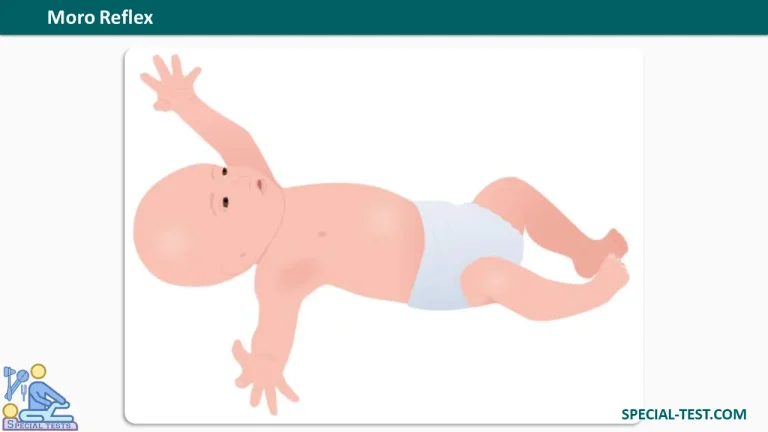
How to perform the "Moro Reflex"?
- The patient is placed supine with both upper and lower limbs in full, natural extension.
- A variety of stimuli can be used to elicit this reflex. Common among the different methods is a sudden extension of the infant’s neck. The examiner can lift the infant in the supine position several inches above the examining table with one hand placed under the infant’s thoracic spine and the other hand under the back of the head. The hand supporting the head is then suddenly removed, allowing neck extension.
- The examiner can also hold the infant in the supine position, supporting the head, back, and legs, then suddenly lower the entire body approximately 2 feet and stop abruptly.
- Alternatively, the infant can be gently raised slightly off the table by holding the infant’s hands and then quickly releasing them, causing sudden extension of the cervical spine.
- The reflex can also be evoked by producing a loud noise (e.g., sharply banging the examination table with the palms of the hand on both sides of the infant’s head) or with a sudden tap on the infant’s abdomen.
What is the positive result?
- The first phase of the Moro reflex consists of sudden abduction and extension of all four limbs and extension of the spine, with extension and fanning of the fingers, except for flexion of the distal phalanges of the index finger and thumb.
- This is followed by the second phase, in which there is adduction and flexion of all four limbs, with the arms coming forward over the body in a clasping movement as if the infant were embracing. The reflex may also be accompanied by crying.
- The Moro reflex is present at birth and gradually disappears by 3 to 6 months of age.
Various conditions can cause abnormalities of this reflex:
- It may be decreased when there is severe hypertonicity because the increased muscle tone prevents full motion of the limbs. Depending on the severity of the hypertonicity, the limbs may move only partially at the height of the reflex, the hands may fail to open, or there may be no response because the limbs are so tightly flexed.
- The Moro reflex may also be decreased or absent in patients with generalized muscle weakness, marked hypotonicity (e.g., amyotonia congenita), or flaccid paralysis.
- In premature infants, the limbs tend to fall backward to the table during the adduction phase because of the weakness of their antigravity muscles.
- The response may be asymmetric if the infant has sustained a peripheral nerve injury (e.g., obstetric brachial plexus paralysis).
- The reflex may persist after it should have disappeared if there is developmental delay of the CNS (as seen in cerebral palsy).