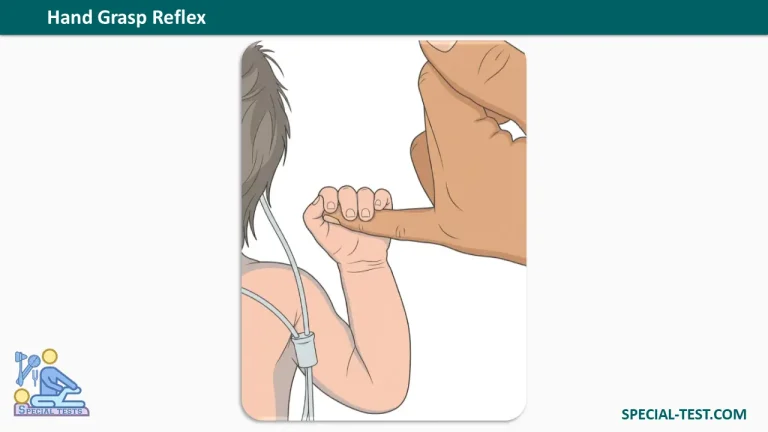
Hand Grasp Reflex
What is the "Hand Grasp Reflex" used for?
- Injury to the roots, plexus, or spinal cord.
- Persistence of the reflex beyond six months is usually present in spastic cerebral palsy
- It can also reappear in adulthood, indicating a cortical lesion affecting the medial or lateral frontal cortex
How to perform the "Hand Grasp Reflex"?
- The hand grasp reflex is tested with the infant supine, the arms semiflexed, and the head in the midline position (not rotated to one side or the other).
- The examiner places a finger or an object (e.g., a pencil, rod, an empty thermometer case) into the infant’s palm from the ulnar side. This stimulates the palm and enhances flexor tonus. The fingers will then flex and grip the object. The thumb will not oppose the fingers but will flex with them if it was in an extended position before the object was introduced.
- If the object is retracted after the infant grasps it, the flexor tone is increased synergistically in other flexor muscles of the upper limb and is facilitated by stretch. This causes the muscles of the arm and shoulder girdle to contract. If the response is marked, the grip is so strong that it is possible to suspend the infant for a moment by the object being held.
- The examiner should assess its intensity and symmetry.
What is the positive result?
- The hand grasp reflex is present in neonates and very young infants, and normally disappears between 2 and 4 months of age. The hand grasp reflex is strongest at birth.
- The reflex may be asymmetric in patients with spastic hemiplegia.
- Absence on one side may indicate flaccid paralysis, such as that seen in obstetric brachial plexus paralysis.
- The reflex should also be assessed for persistence after it should have normally disappeared. Persistence in infants older than 4 months may be an indication of flexor hypertonicity, as is seen in spastic cerebral palsy.