Published July 15, 2026Read time 2 min readReaders 18
What is the "Step Down Test" used for?
Step Down Test is a functional task used to assess lower extremity movement quality involving weight-bearing stress as well as dynamic muscular control.
It’s sometimes called lateral step-down test (LSD Test).
How to perform the "Step Down Test"?
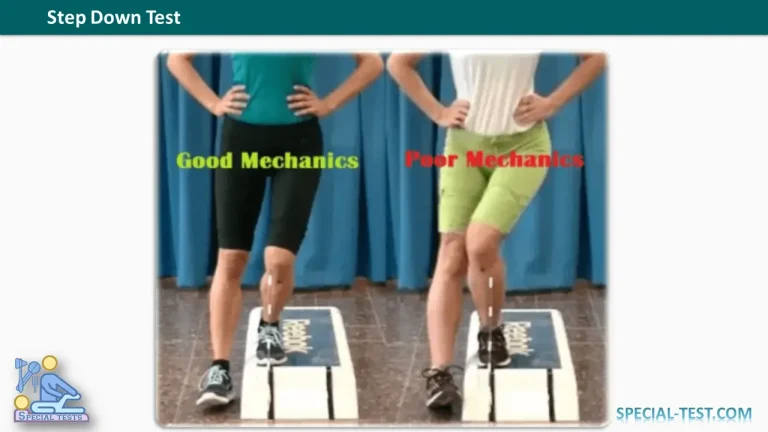
The patient stands on a 20 cm step, with the foot of the tested limb close to the edge of the step and the non-tested limb positioned in front of the step, with the knee straight and the ankle at maximum dorsiflexion.
The patient is asked to keep the trunk straight and the hands on the waist and to bend the knee on the tested side until the heel of the non-tested limb touches the floor.
The patient is asked not to apply any weight on the heel of the non-tested limb once it reaches the floor and to immediately reextend the knee of the tested limb to return to the starting position.
The examiner rates the performance of the patient across five repetitions.
What is the positive result?
Positive step down test with the pelvis tilting down and away from supporting limb (Trendelenburg sign) and supporting knee collapsing medially into valgus.
Test Accuracy
The kappa coefficient and percent agreement for rating the quality of movement on the Forward Step Down test were 0.80 (95% confidence interval: 0.57, 1.00) and 85%, respectively.