Published August 17, 2026Read time 2 min readReaders 20
What is the "Femoral Nerve Stretch Test" used for?
Femoral Nerve Stretch Test (or Ely test) is a way of eliciting root stretch in the evaluation of high lumbar radiculopathy.
The femoral nerve stretch test is probably the single best screening test to evaluate for a high lumbar radiculopathy.
How to perform the "Femoral Nerve Stretch Test"?
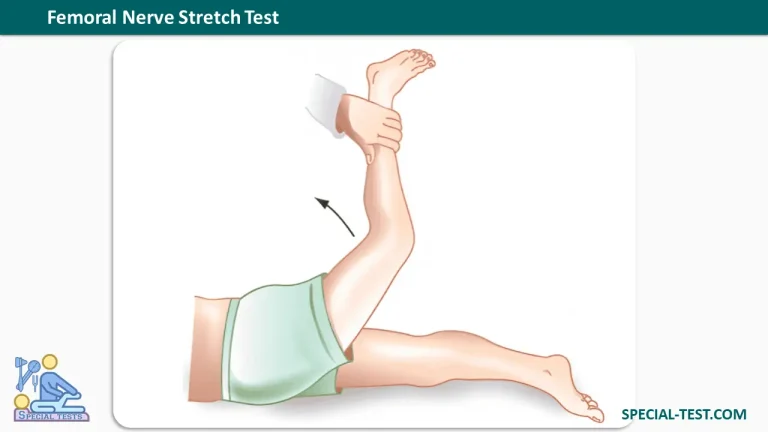
The patient lies prone on the examination table with a pillow under the abdomen,
the knee is pulled into maximum flexion, or the examiner pulls upward on the extended knee to passively extend the hip.
In the bent knee pulling test, the patient’s knee is flexed and the examiner pulls upward on the ankle while pushing the buttock forward (in the same way as for eliciting the psoas sign used in the diagnosis of appendicitis).
If the patient cannot lie prone, the test can be performed in side-lying with the pelvis stabilized.
What is the positive result?
In the normal patient, this maneuver induces only a mild feeling of tightness in the anterior thigh.
When one of the nerve roots that contribute to the femoral nerve is compressed, this maneuver reproduces the patient’s radicular pain in the anterior thigh (positive Femoral Nerve Stretch Test).
Test Accuracy
This test has been shown to be positive in 84–95% of patients with high lumbar disks, although the test may be falsely positive in the presence of an adaptively shortened iliopsoas or rectus femoris or any pathology in or about the hip joint, sacroiliac joint, and lumbar spine.
References
Sarvdeep S. Dhatt, Sharad Prabhakar – Handbook of Clinical Examination in Orthopedics. An Illustrated Guide-Springer Singapore.
Dutton’s Orthopaedic Examination, Evaluation, And Intervention 3rd Edition.
AG, Swenson RS. Disorders of the Nervous System: A Primer. New Haven: Dartmouth Medical School, 2004. Retrieved on August 28, 2018.