Published August 31, 2026Read time 2 min readReaders 17
What is the "Standing Flexion Test" used for?
Standing flexion test (also called Piedallu test) is used to assess sacroiliac joint function.
How to perform the "Standing Flexion Test"?
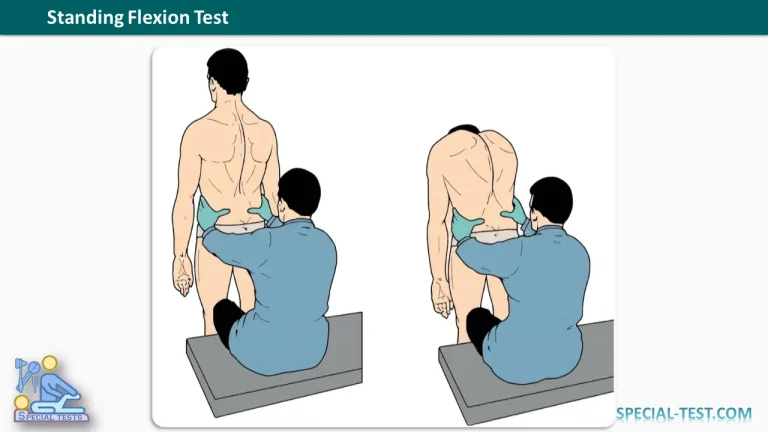
Standing flexion test is done with the patient stands with his or her back to the examiner.
The examiner’s thumbs simultaneously palpate both posterior superior iliac spines.
The patient is asked to slowly bend over while keeping both feet in contact with the floor and the knees extended.
The examiner observes the position and/or motion of both iliac spines as the patient’s torso bends forward.
What is the positive result?
The sacrum rotates relative to the ilia around a horizontal axis in the sacroiliac joints, this motion is referred to as “nutation.”
In normal patients with mobile sacroiliac joints, the two posterior superior iliac spines will be level with each other throughout the range of motion when the patient bends over.
If nutation does not occur in the sacroiliac joint on one side, the posterior superior iliac spine on that side will come to rest farther superior with respect to the sacrum than the spine on the contralateral side.
Where nutation fails to occur or this relative superior advancement is observed, this is usually a sign of a blockade in the ipsilateral sacroiliac joint.
Bilateral superior advancement can be simulated by bilateral shortening of the hamstrings.
References
Clinical Tests for the Musculoskeletal 3rd Ed. Book