Three-Phase Hyperextension Test
What is the "Three-Phase Hyperextension Test" used for?
- Three-Phase Hyperextension Test (or Mennell sign) is used to differentiate whether the pathology is in the lumbar spine, the sacroiliac joint or the hip joint.
How to perform the "Three-Phase Hyperextension Test"?
The patient is prone.
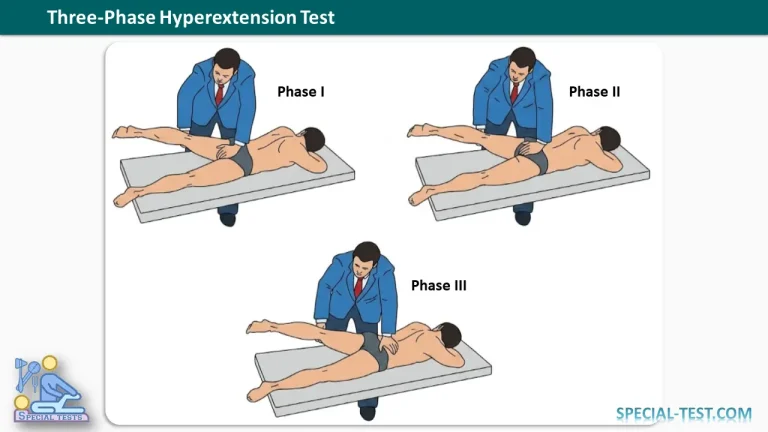
- In the first phase of the test, the examiner grasps the patient’s extended leg and raises it into hyperextension while immobilizing the pelvis with the other hand.
- In the second phase, the examiner immobilizes the patient’s sacrum parallel to the sacroiliac joint with the same hand and passively raises the patient’s leg into hyperextension.
- In the third phase, the examiner immobilizes the fifth lumbar vertebra with the heel of one hand while passively guiding the patient’s leg into hyperextension with the other hand.
By moving the immobilizing hand up the spine, the examiner can also evaluate higher segments of the lumbar spine.
What is the positive result?
- Under normal conditions no pain should occur in any phase of the test.
- The hip should allow about 10 to 20° of hyperextension.
- The sacroiliac joint should exhibit slight movement (joint play), and the lumbar spine should allow elastic hyperextension (lordosis) at the lumbosacral junction.
- phase 1: Pain with the ilium immobilized suggests a hip disorder or muscle contracture (rectus femoris and/or psoas).
- phase 2: Pain when the sacrum is immobilized suggests motion restriction of the sacroiliac joint or other disorders of this joint, such as ankylosing spondylitis (Mennell sign).
- phase 3: While pain when the lumbar spine is immobilized suggests a disorder of the lumbosacral junction (vertebral motion restriction or protrusion or extrusion of an intervertebral disk).
References
- Clinical Tests for the Musculoskeletal 3rd Ed. Book