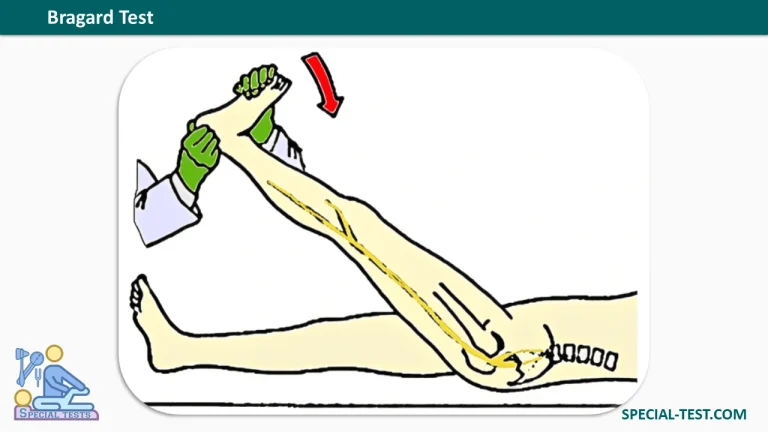
Bragard Test
What is the "Bragard Test" used for?
- Bragard Test is used to evaluate nerve root compression, differentiating a genuine Lasegue sign from a pseudo-Lasegue sign.
How to perform the "Bragard Test"?
- The patient is supine.
- The examiner grasps the patient’s heel with one hand and anterior aspect of the knee with the other.
- The examiner slowly raises the patient’s leg, which is extended at the knee.
- At the onset of the Lasegue sign, the examiner lowers the patient’s leg just far enough that the patient no longer feels pain.
- The examiner then passively moves the patient’s foot into extreme dorsiflexion in this position, eliciting the typical pain caused by stretching of the sciatic nerve.
What is the positive result?
- A positive Bragard test is evidence of nerve root compression, which may lie between L4 and S1.
- Dull, nonspecific pain in the posterior thigh radiating into the knee is attributable to stretching of the hamstrings and should not be assessed as a Lasegue sign.
- A sensation of tension in the calf may be attributable to thrombosis, thrombophlebitis, or contracture of the gastrocnemius.
- The Bragard sign can be used to test whether the patient is malingering. The sign is usually negative in malingerers.
Test Accuracy
- Sensitivity: 69.3%
- Specificity: 67.42%
References
- Clinical Tests for the Musculoskeletal 3rd Ed. Book
- NCBI