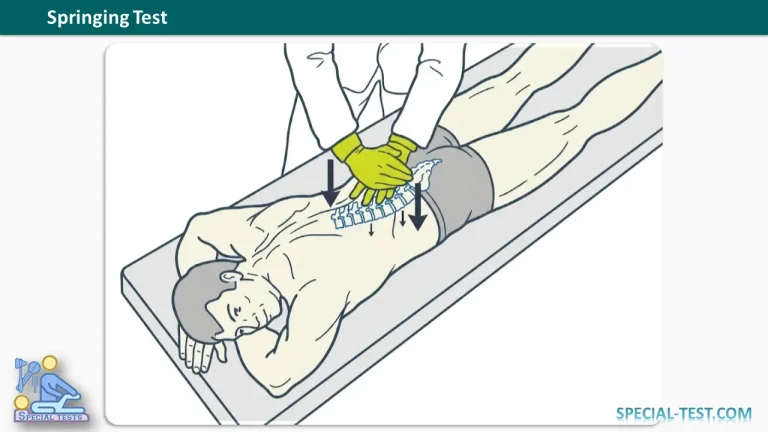
Springing Test
What is the "Springing Test" used for?
- Springing Test is used for localization of functional impairments in the lumbar spine, it’s also used to examine posterior longitudinal ligament.
How to perform the "Springing Test"?
- The patient is prone.
- The examiner palpates the articular processes or laminae of the vertebrae with his or her index and middle
fingers.
- With the ulnar edge of the other hand, which is held perpendicularly over the palpating fingers, the examiner repeatedly presses lightly in a posteroanterior direction.
What is the positive result?
- Where joint function is intact, the articular processes or laminae will be resilient.
- Lack of resiliency or excessive resiliency is a sign of abnormal segmental mobility, in the former case a blockade and in the latter case hypermobility.
- Springing test is also a provocation test for the posterior longitudinal ligament in particular and will result in an increase in the deep, dull low back pain that is typical of this structure and is difficult to localize.
References
- Clinical Tests for the Musculoskeletal 3rd Ed. Book