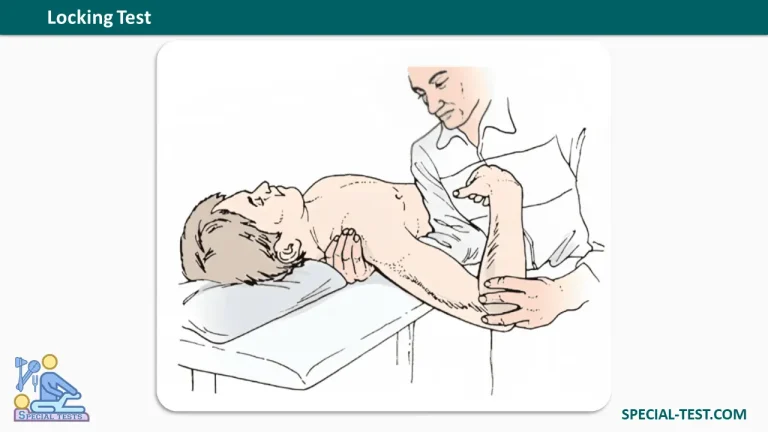
Locking Test
What is the "Locking Test" used for?
- The locking position compresses the subacromial space and gives pain with an impingement syndrome.
- The locking position combines internal rotation, extension and abduction of the shoulder with the scapula fixed. In this position the subacromial space is compressed and will give pain should an impingement syndrome be present.
- Cadaveric studies have shown that in the locking position the posterosuperior tip of the glenoid is in contact with the humeral head
How to perform the "Locking Test"?
- To perform the test, the patient is in a supine position, and the practitioner stands by the patient’s side towards the shoulders.
- The examiner places the palmar aspect of his or her forearm beneath the patient’s shoulder, and grips the trapezius muscle to stop the shoulder shrugging.
- The examiner holds the patient’s elbow, slightly medially rotates the arm, and lifts it into abduction.
What is the positive result?
- Positive findings for this test include reproduction of the patient’s symptoms and a decrease in ROM compared with the uninvolved shoulder.
References