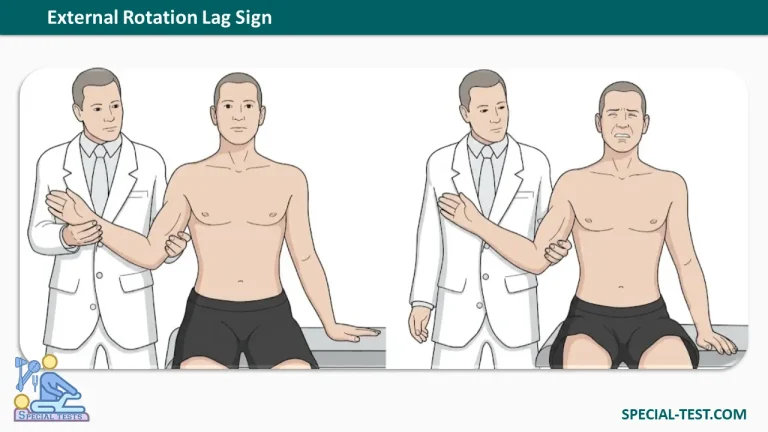
External Rotation Lag Sign
What is the "External Rotation Lag Sign" used for?
- Integrity of the supraspinatus and infraspinatus tendons
How to perform the "External Rotation Lag Sign"?
- The patient is seated with his or her back to the examiner.
- The elbow is passively flexed to 90 degrees, and the shoulder is held at 20 degrees of elevation and near maximal external rotation (maximal external rotation minus 5 degrees to avoid elastic recoil in the shoulder) by the examiner.
- The patient is asked to maintain the position of external rotation actively as the examiner releases the wrist, while maintaining support of the arm at the elbow
What is the positive result?
- The sign is positive when a lag, or angular drop, occurs
Test Accuracy
- Sensitivity: 56 %
- Specificity: 98 %
References
- Campbel’s Operative Orthopaedics Book