Published September 10, 2026Read time 2 min readReaders 47
What is the "Patellar Ballottement (Patellar Tap Test)" used for?
Ballottement of the patella is a useful technique for detecting knee effusion.
How to perform the "Patellar Ballottement (Patellar Tap Test)"?
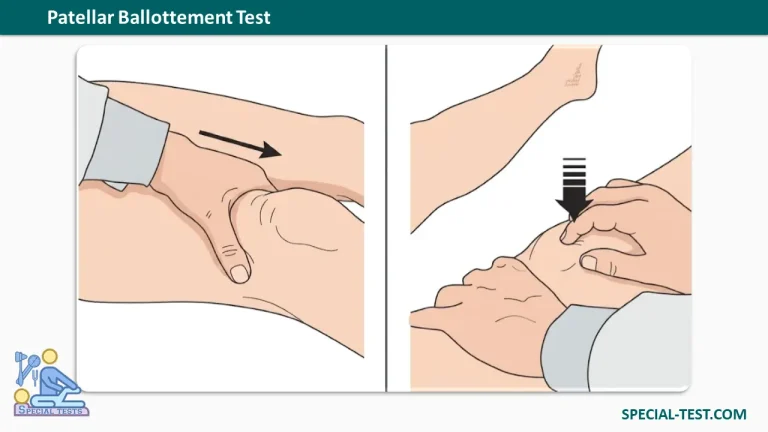
Using one hand, the clinician grasps the patient's thigh at the anterior aspect about 10 cm above the patella, placing the fingers medial and the thumb lateral.
The patient's knee is extended.
With the other hand, the clinician grasps the patient's lower leg about 5 cm distal to the patella, placing the fingers medial and the thumb lateral.
The proximal hand exerts compression against the anterior, lateral, and medial aspects of the thigh and, while maintaining this pressure, slides distally.
The distal hand exerts compression in a similar way and slides proximally.
Using the index finger of the distal hand, the clinician now taps the patella against the femur.
What is the positive result?
In the normal knee joint with minimal free fluid, the patella moves directly into the femoral condyle and there is no tapping sensation underneath the clinician's fingertips.
However, in the knee with excess fluid, the patella is "floating"; thus, ballottement causes the patella to tap directly against the femoral condyle. This sensation is transmitted to the clinician's fingertips.
A positive test is indicative of a significant synovial effusion or hemarthrosis in the knee joint.
However, sometimes, this test can produce false-positive results. When this is the case, the uninvolved side usually tests positive as well.
References
Dutton’s Orthopaedic Examination, Evaluation, And Intervention 3rd Edition.