Wilson Test
What is the "Wilson Test" used for?
- Wilson Test is a provocative test that can be performed when osteochondritis dissecans of the knee is suspected.
How to perform the "Wilson Test"?
Supine Position
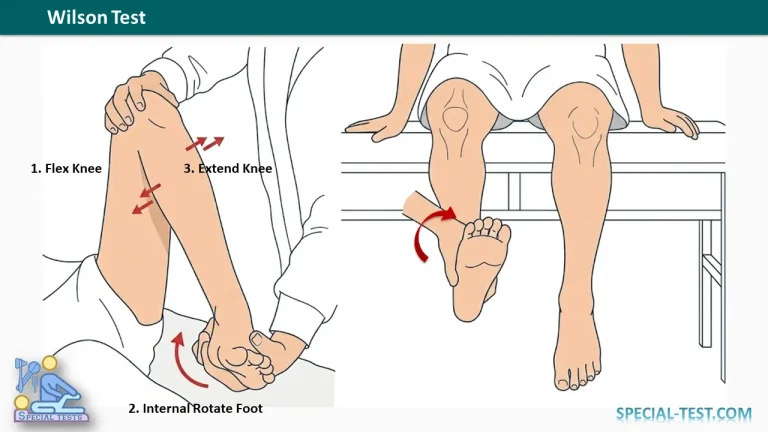
- With the patient in a supine position, the examiner grasps the knee above the patella with one hand and simultaneously palpates the area around the medial joint space. He or she passively flexes the patient’s hip and knee to 90 degrees.
- Then he or she asks the patient to actively extend the knee gradually while maintaining the tibia in internal rotation and to let the examiner know if pain occurs (This causes impingement of the ACL against the osteochondritis dissecans lesion on the medial cartilaginous surfaces).
- From this position, the patient is instructed to externally rotate the tibia.
Sitting Position
- Ask the patient to sit on a table with his legs dangling over the edge.
- Bend the patient’s knee so that it is flexed at a 90° angle.
- Grasp the patient’s foot and bring the tibia in internally rotation.
- Instruct the patient to extend his leg until he/she feels pain.
What is the positive result?
- In osteochondritis dissecans, joint pain occurs between 20 and 30° from the pressure on the joint and from the palpating fingers. The pain is typically reduced by external rotation of the lower leg.
- The test is positive if pain experienced during extension with internal tibial rotation is relieved by externally rotating the tibia.
- The classic site for osteochondritis dissecans and the pain that radiates from it is on the medial femoral condyle near the intercondylar fossa.
Test Accuracy
- Wilson’s sign was of minimal clinical diagnostic value. When positive, the sign is useful as a clinical monitor during treatment.
- It is not frequently used and has been shown to have a low rate of sensitivity.
References