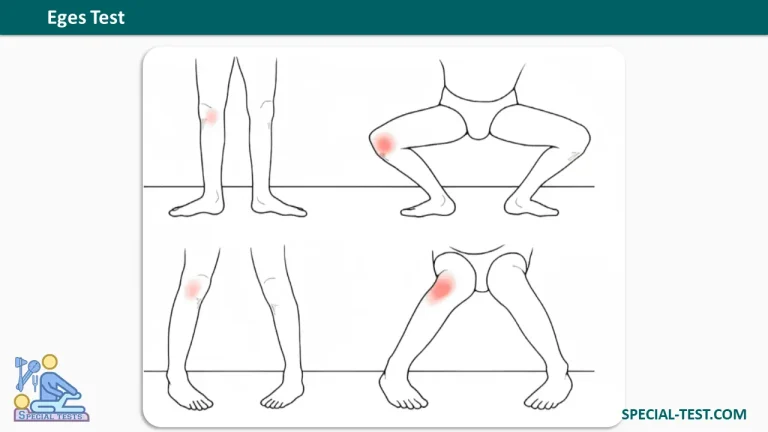
Ege’s Test
What is the "Ege's Test" used for?
- It’s used to detect a tear of the meniscus of the knee.
How to perform the "Ege's Test"?
- It is performed in a standing position, the knees are in extension and the patient stands with feet 30-40cm apart.
- For Medial meniscus tears:
- The patient squats with both lower legs in maximum external rotation and then stands up slowly.
- The distance between the knees increases and each knee becomes externally rotated as the squatting proceeds.
- By performing the squat in maximum external rotation, genu varus will be induced.
- The patient squats as far as possible and then returns to the starting position (extension of the knee).
- For Lateral meniscus tears:
- Both lower extremities are held in maximum internal rotation of the knee while the patient squats and stands up.
- The distance between the knees decreases and the knees become internally rotated as the squatting proceeds.
- By performing the squat in maximal internal rotation, genu valgus will be induced.
- The patient squats as far as possible and then returns to the starting position (extension of the knee).
What is the positive result?
- The test is positive when pain and/or a click is felt by the patient at the related site of the joint line.
- Pain and/or click are typically felt at around 90° of knee Flexion
Test Accuracy
- Sensitivity: 67 %
- Specificity: 81 %
References
- Campbell book 12th edition.
- Filardo, G., Andriolo, L., Naouri, J.F., Perdisa, F., Lefevre, N. (2016). Clinical Examination, Standard X-Rays. In: Hulet, C., Pereira, H., Peretti, G., Denti, M. (eds) Surgery of the Meniscus. Springer, Berlin, Heidelberg. https://doi.org/10.1007/978-3-662-49188-1_13