Published August 27, 2026Read time 1 min readReaders 32
What is the "Duncan Ely Test" used for?
Duncan Ely Test or Ely test is used to assess the rectus femoris muscle tightness at the hip joint.
How to perform the "Duncan Ely Test"?
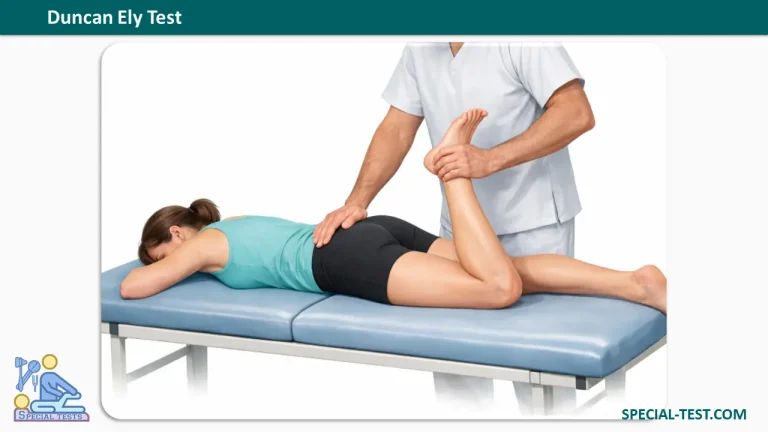
The patient is positioned prone with knees kept in extension. The knee joint is passively flexed on the side of examination by the examiner.
Normally, there is no motion of the hip or pelvis while the knee flexes completely.
What is the positive result?
In patients with rectus femoris contracture, complete passive knee flexion results in involuntary flexion at the hip, elevating the buttocks of the examination table.
Lee, S.Y., Sung, K.H., Chung, C.Y., Lee, K.M., Kwon, S.-S., Kim, T.G., Lee, S.H., Lee, I.H. and Park, M.S. (2015), Reliability and validity of the Duncan-Ely test for assessing rectus femoris spasticity in patients with cerebral palsy. Dev Med Child Neurol, 57: 963-968. https://doi.org/10.1111/dmcn.12761
Marks MC, Alexander J, Sutherland DH, Chambers HG. Clinical utility of the Duncan-Ely test for rectus femoris dysfunction during the swing phase of gait. Dev Med Child Neurol. 2003 Nov;45(11):763-8. doi: 10.1017/s0012162203001415. PMID: 14580132.