Published August 17, 2026Read time 2 min readReaders 19
What is the "Prone Hip Extension Test (Staheli test)" used for?
Sometime called Staheli test.
Prone Hip Extension Test is used to evaluate the hip flexion contracture.
It can also be performed in patients with bilateral hip pathology.
How to perform the "Prone Hip Extension Test (Staheli test)"?
The prone hip extension test can be performed on a regular padded examination table.
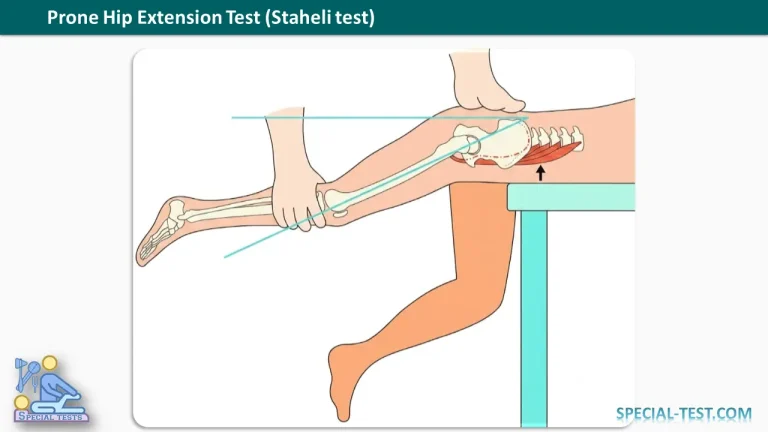
The patient is positioned prone with both hips flexed comfortably over the end of the examination couch.
The patient is adequately undressed to allow visualization of the back.
The other limb can be held between the examiner’s knees, can be kept on a stool, or can be hung from the edge of the table.
The examiner slowly extends the thigh while placing the other hand over the pelvis.
What is the positive result?
The point at which the pelvis begins to rise denotes the termination of extension at the hip joint and the beginning of movement at the spine.
At this point, the angle between an imaginary horizontal line parallel to the trunk and thigh gives the value of hip flexion contracture.
References
Staheli LT. The prone hip extension test: a method of measuring hip flexion deformity. Clin Orthop Relat Res. 1977 Mar-Apr;(123):12-5. PMID: 852171.
Moon, Seung & Choi, Young & Chung, Chin & Sung, Ki & Cho, Byung & Chung, Myung & Kim, Jaeyoung & Yoo, Mi & Lee, Hyung & Park, Moon Seok. (2017). Normative Values of Physical Examinations Commonly Used for Cerebral Palsy. Yonsei Medical Journal. 58. 1170. 10.3349/ymj.2017.58.6.1170. Link