Craig Test
What is the "Craig Test" used for?
- The Craig test (or Femoral Anteversion test) is used to assess anteversion/ retroversion of the femoral neck.
How to perform the "Craig Test"?
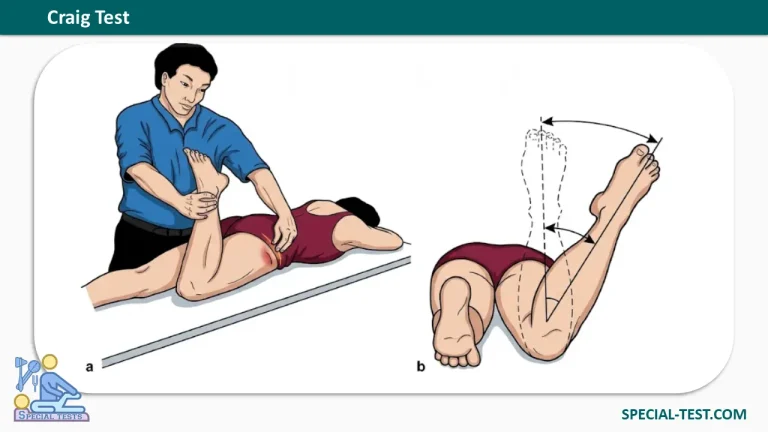
- The patient is positioned in prone with the knee flexed to 90 degrees.
- The clinician rotates the hip through the full ranges of hip internal and external rotation, while palpating the greater trochanter and determining the point in the range at which the greater trochanter is the most prominent laterally.
What is the positive result?
- The femoral anteversion angle can be measured when the greater trochanter is most prominent laterally.
- If at this point the angle is greater than 8–15 degrees in the direction of internal rotation, when measured from the vertical and long axis of the tibia, the femur is considered to be in anteversion.
- The femoral anteversion angle can be estimated directly on the basis of the angle by which the lower leg deviates from the vertical. In this position, the femoral neck lies in the horizontal plane while the condyles of the knee and the lower leg indicate the anteversion angle.
- The precision of this measurement performed by an experienced examiner is comparable to that of radiographic measurement.
Test Accuracy
- One study showed this test to be accurate to within 4 degrees of intraoperative measurements, for the assessment of femoral anteversion/retroversion, and was more accurate than radiographic measurement techniques.
References
- Clinical Tests for the Musculoskeletal System 3rd Edition.
- Dutton’s Orthopaedic Examination, Evaluation, And Intervention 3rd Edition.
- Craig Test | Orthofixar