Hip Quadrant Test
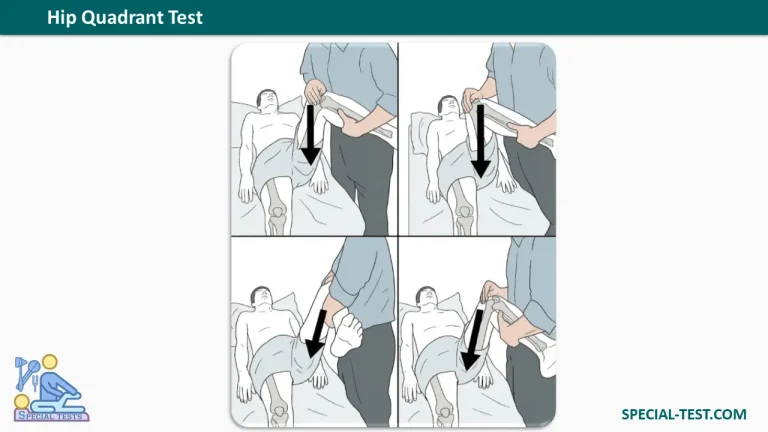
What is the "Hip Quadrant Test" used for?
- The Hip quadrant test (or as it called scour test) is a dynamic test of the inner and outer quadrants of the hip joint surface.
How to perform the "Hip Quadrant Test"?
The patient is positioned in supine, close to the edge of the bed, with their hip flexed and foot resting on the bed. The clinician places one hand over the top of the patient’s knee.
- The patient’s hip is placed in 90 degrees of flexion, with the knee being allowed to flex comfortably. From this point, the clinician adducts the hip to the point at which the patient’s pelvis begins to lift off the bed, to assess the inner quadrant.
- At the end range of flexion and adduction, a compression force is applied through the knee along the longitudinal axis of the femur. From this point, the clinician moves the hip into a position of flexion and abduction to examine the outer quadrant.
Throughout the entire movement, the femur is held midway between internal and external rotation, and the movement at the hip joint should follow the smooth arc of a circle.
What is the positive result?
An abnormal finding is resistance, apprehension, or pain felt anywhere during the arc (positive Quadrant Test).
The pain can result from compression of, or stress to, a number of structures by the femur through the various ranges, the structures are:
- The articular surfaces of the hip joint;
- The labrum;
- The hip joint capsule;
- The insertion of the Tensor fasciae latae and the sartorius muscles;
- The iliopsoas muscle;
- The Iliopsoas Bursa and neurovascular bundle;
- The insertion of the pectineus muscle;
- The insertion of the adductor longus muscle;
- The femoral neck.
The resistance may be caused by:
- Capsular tightness,
- An adhesion,
- A myofascial restriction,
- A loss of joint congruity.
Test Accuracy
- Sensitivity: 75 %
- Specificity: 43%
References
- Dutton’s Orthopaedic Examination, Evaluation, And Intervention 3rd Edition.
- Maslowski, E., Sullivan, W., Forster Harwood, J., Gonzalez, P., Kaufman, M., Vidal, A. and Akuthota, V. (2010), The Diagnostic Validity of Hip Provocation Maneuvers to Detect Intra-Articular Hip Pathology. PM&R, 2: 174-181. https://doi.org/10.1016/j.pmrj.2010.01.014