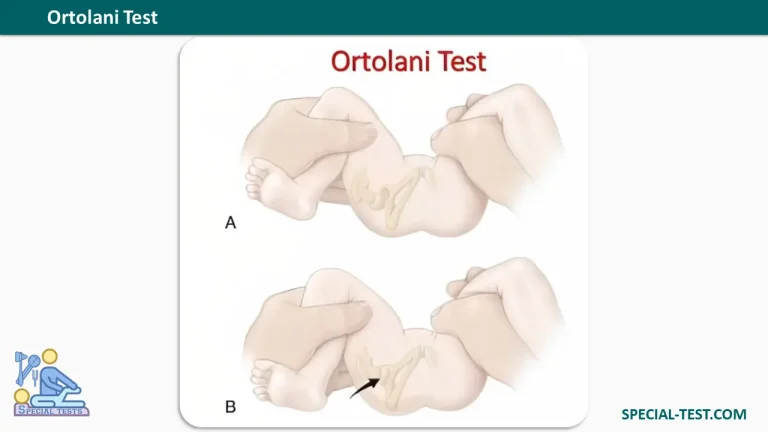
Ortolani’s Test
What is the "Ortolani’s Test" used for?
- Developmental dysplasia of the hip in newborn.
How to perform the "Ortolani’s Test"?
- It must be carried out on a relaxed child, preferably after feeding.
- Flex the knees and encircle them with the hands so that the thumbs lie along the medial sides of the thighs and the fingers over the trochanters.
- Flex the hips to a right angle and, starting from a position where the thumbs are touching, abduct the hips smoothly and gently.
What is the positive result?
- If a hip is dislocated, as full abduction is approached the femoral head will be felt slipping into the acetabulum. An audible click may accompany the displacement.
- Note that restriction of abduction may be pathological, and represent an irreducible dislocation.
- A positive Ortolani test is indicative of neonatal instability of the hip (NIH), and is usually an indication for splintage.
Test Accuracy
- Sensitivity: 66 %
- Specificity: 95 %
References