The Silfverskiöld Test: Purpose, Procedure, and Interpretation
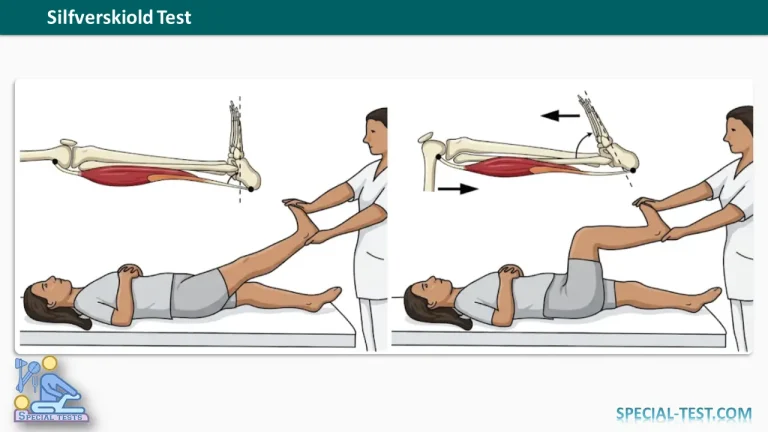
What is the Silfverskiöld Test?
The Silfverskiöld test (often spelled Silfverskiold test) is a clinical orthopedic examination used to differentiate the underlying cause of an ankle equinus deformity or ankle joint contracture. Specifically, it helps determine whether the restriction in ankle dorsiflexion is caused by an isolated gastrocnemius muscle contracture or a combined Achilles tendon (or soleus-gastrocnemius complex) contracture.
Because the gastrocnemius is a bi-articular muscle crossing both the knee and the ankle joints, its tension changes depending on knee position. The soleus and Achilles tendon, however, only cross the ankle joint and remain unaffected by knee flexion.
How to Perform the Silfverskiöld Test
The examination is straightforward and typically performed with the patient in a supine (lying on their back) or seated position:
- Test with Knee Extended:
- The examiner stabilizes the leg and passively dorsiflexes the patient’s foot as far as possible while keeping the knee in full extension ($0^\circ$).
- The available range of ankle dorsiflexion is measured and recorded.
- Test with Knee Flexed:
- The examiner then flexes the patient’s knee to $90^\circ$ to slacken the gastrocnemius muscle.
- The foot is passively dorsiflexed again, and the new range of motion is measured.
Interpreting Test Results: Positive vs. Negative Findings
Evaluating how ankle dorsiflexion changes between the extended and flexed knee positions reveals the source of the tightness:
- Isolated Gastrocnemius Contracture (Positive Test):
- Ankle dorsiflexion is severely limited when the knee is fully extended.
- Dorsiflexion significantly improves (increases) when the knee is flexed to $90^\circ$.
- Reason: Flexing the knee relaxes the gastrocnemius, proving that the restriction stems solely from this bi-articular muscle rather than the deep Achilles tendon complex.
- Achilles Tendon / Combined Contracture (Negative Differential Test):
- Ankle dorsiflexion remains equally limited regardless of whether the knee is flexed or extended.
- Reason: Because the soleus muscle and Achilles tendon originate below the knee, tension remains constant across both positions, pointing to a generalized tightness of the Achilles tendon or combined soleus-gastrocnemius contracture.
Test Reliability and Clinical Significance
While the Silfverskiöld test is a foundational diagnostic tool in podiatry and orthopedics for planning surgical interventions like gastrocnemius recession or Achilles tendon lengthening, studies indicate it has poor inter- and intrarater reliability. Consequently, clinicians often use it alongside dynamic imaging or gait analysis for precise surgical planning.
References
- Symeonidis P. The Silfverskiöld Test. Foot Ankle Int. 2014 Aug;35(8):838. doi: 10.1177/1071100714535202. Epub 2014 Jul 30. PMID: 25080357.
- Clinical Assessment and Examination in Orthopedics, 2nd Edition Book.
- Orthofixar – Silfverskiold Test