Matles Test for Achilles Tendon Rupture: Procedure, Accuracy & Interpretation
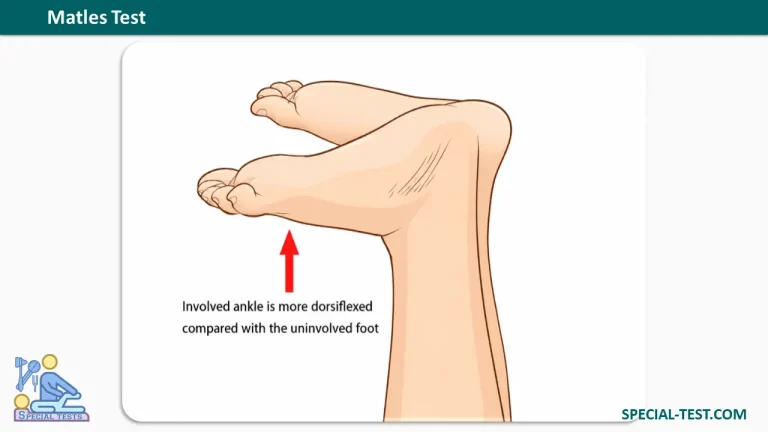
In addition to the Thompson test, the Matles test is another essential clinical examination used by healthcare professionals to detect an Achilles tendon rupture. This active test relies on the patient’s own muscle contraction rather than manual squeezing, making it a valuable tool in orthopedic and sports medicine evaluations.
This guide explains how to perform the Matles test, how to interpret the results, and its diagnostic accuracy.
What is the Matles Test Used For?
The primary purpose of the Matles test is to identify a complete Achilles tendon tear. Because it is an active test requiring the patient to bend their knee against gravity, it helps evaluate the resting tension and functional continuity of the gastrocnemius-soleus complex.
How to Perform the Matles Test
The examination is straightforward and non-invasive:
- Patient Position: The patient lies prone (face down) on the examination table with their feet hanging relaxed over the edge.
- Clinician Position: The examiner stands at the foot of the table observing the lower leg.
- The Maneuver: The patient is asked to actively flex (bend) their knee to 90 degrees, while the clinician closely observes the position and movement of the foot throughout the entire motion.
What is a Positive Matles Test Result?
- Normal (Negative Test): In an uninjured leg, as the knee bends to 90 degrees, the normal resting tension of the Achilles tendon causes the foot to naturally pull into plantarflexion (pointing downward).
- Abnormal (Positive Test): If the foot falls into a neutral position or slight dorsiflexion (or simply loses its normal plantarflexed resting posture) during knee flexion, the test is positive for an Achilles tendon rupture.
Matles Test Diagnostic Accuracy
While slightly less sensitive than the Thompson test, the Matles test remains a reliable clinical indicator:
- Sensitivity: 88%
- Specificity: 85%
- Note: Combining both the Thompson and Matles tests provides clinicians with a comprehensive clinical picture for diagnosing Achilles injuries.
References
- Periasamy, Madhu, Hari Venkatramani, and Raja Sabapathy. (2019). “Management of Chronic Achilles Tendon Injuries—Review of Current Protocols and Surgical Options.” Indian Journal of Plastic Surgery, 52. doi:10.1055/s-0039-1687923.
- Dutton’s Orthopaedic Examination, Evaluation, And Intervention, 3rd Edition.