Hoffa Sign: Purpose, Technique, and Clinical Interpretation
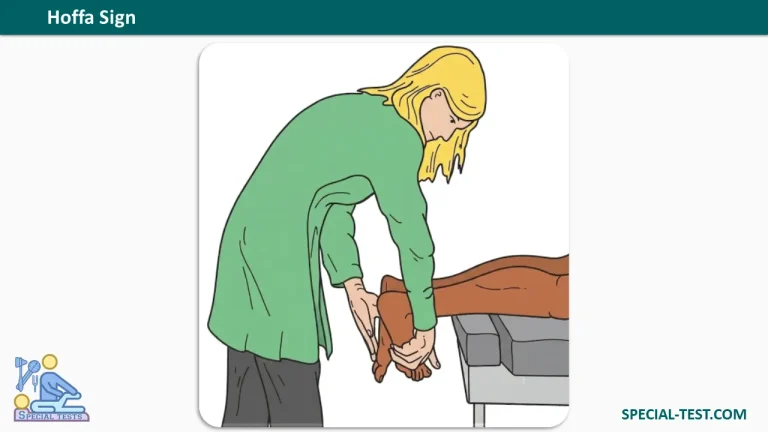
What is the Hoffa Sign?
The Hoffa Sign is a specialized orthopedic clinical test used primarily by physical therapists, orthopedic surgeons, and sports medicine specialists to detect a chronic Achilles tendon tear.
When an Achilles tendon rupture goes unnoticed or untreated in the acute phase, changes in muscle tension and tendon fiber continuity occur. The Hoffa Sign helps clinicians identify these missed or chronic tears during a physical examination.
How to Perform the Hoffa Sign Test
To perform the Hoffa Sign accurately, follow these clinical steps:
- Patient Positioning: Position the patient in a prone (face-down) position on the examination table, with both feet hanging freely off the edge.
- Examiner Action: The examiner passively dorsi flexes both of the patient’s feet simultaneously or sequentially to compare range of motion.
Interpreting the Results
1. Passive Dorsiflexion Test
- Positive Result: In a chronic Achilles tendon tear, the normal resting tension of the Achilles tendon is significantly reduced or lost. As a result, the affected foot can be dorsi flexed farther than the healthy contralateral foot.
2. Functional Single-Leg Heel Raise Test
- Follow-Up Action: The patient is asked to stand on tiptoe (perform a single-leg heel raise) on each leg independently.
- Positive Result: With a full Achilles tendon tear, active plantarflexion is severely compromised, making it impossible to stand on tiptoe on the injured leg.
References
- Clinical Tests for the Musculoskeletal System, 3rd Edition.
- Dutton’s Orthopaedic Examination, Evaluation, And Intervention, 3rd Edition.