What is the Feiss Line Test? Purpose, Procedure, and Results
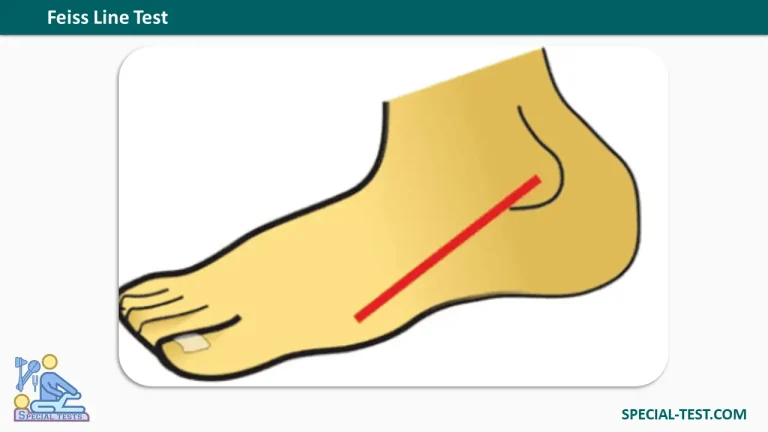
The Feiss Line Test is a clinical orthopedic examination used to assess the height of the medial longitudinal arch of the foot by evaluating the position of the navicular bone. Often used by physical therapists, podiatrists, and sports medicine clinicians, this simple screening tool helps identify and grade flatfoot deformity (pes planus).
How to Perform the Feiss Line Test
Performing the test involves a straightforward physical assessment in both non-weight-bearing and weight-bearing positions:
- Step 1 (Landmark Identification): With the patient in a non-weight-bearing position, the clinician locates and marks two primary bony landmarks:
- The apex of the medial malleolus (ankle bone).
- The plantar aspect of the first metatarsophalangeal (MTP) joint (the base of the big toe).
- Step 2 (Drawing the Line): An imaginary or physical line is drawn connecting these two points. This is known as the Feiss Line.
- Step 3 (Navicular Palpation): The clinician palpates the navicular tuberosity on the medial midfoot and notes its initial position relative to the Feiss line.
- Step 4 (Weight-Bearing Assessment): The patient is instructed to stand upright with their feet positioned approximately 3 to 6 inches apart, distributing their weight evenly. The clinician then observes how far the navicular drops relative to the line.
Interpreting Feiss Line Test Results
In a normal, healthy foot during weight-bearing, the navicular bone will lie on or very close to the Feiss line.
When the navicular drops excessively below the line during weight-bearing, it indicates a flatfoot deformity. The severity is graded into three degrees:
- First-Degree Flatfoot: The navicular falls approximately one-third of the distance from the Feiss line to the floor.
- Second-Degree Flatfoot: The navicular falls approximately two-thirds of the distance to the floor.
- Third-Degree Flatfoot: The navicular drops completely, resting on the floor.
Clinical Reliability and Limitations
While the Feiss line test provides a practical visual classification for midfoot mobility and arch height, formal diagnostic accuracy studies establishing its precise sensitivity and specificity remain limited in clinical literature. Clinicians typically use it alongside other evaluations (such as the Foot Posture Index or gait analysis) for a comprehensive foot assessment.