Understanding Ankle Range of Motion: Why Flexibility and Mobility Matter
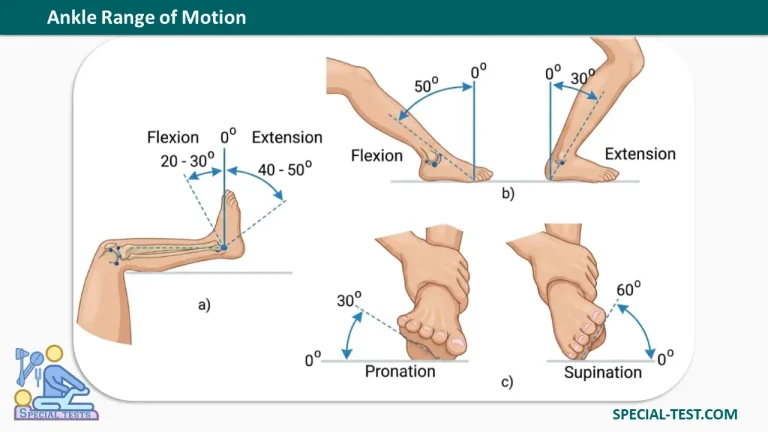
When we think about fitness, running, or even just walking comfortably, our ankles often get overlooked. However, your ankles are the foundation of your lower body mechanics. Knowing the normal measurements for your ankle range of motion (ROM) can help you prevent injuries, improve athletic performance, and recover faster from sprains.
Whether you are an athlete, a physical therapy patient, or just looking to improve your daily mobility, here is a complete guide to understanding ankle movements and degrees.
Normal Ankle Range of Motion Measurements
Medical and fitness professionals use a goniometer to measure joint angles in degrees. Below are the standard benchmarks for a healthy adult ankle:
| Movement | Degrees |
| Dorsiflexion | 20° – 30° |
| Plantar flexion | 40° – 50° |
| Rotation | 5° |
| Pronation | 30° |
| Supination | 60° |
Breaking Down the 5 Key Ankle Movements
1. Dorsiflexion (20-30 Degrees)
- What it is: Pulling your toes up toward your shin.
- Why it matters: Dorsiflexion is crucial for walking, squatting, and running. If your dorsiflexion is limited, your body will compensate, often leading to knee pain, shin splints, or lower back strain during deep squats.
2. Plantar Flexion (40-50 Degrees)
- What it is: Pointing your toes downward away from your body (like pressing a car gas pedal or standing on your tiptoes).
- Why it matters: This movement provides the explosive push-off power needed for running, jumping, and sprinting.
3. Rotation (5 Degrees)
- What it is: The circular movement of the ankle joint as a whole.
- Why it matters: While the true rotation at the ankle joint is relatively small (about 5 degrees), it works in tandem with the subtalar joint to help your foot adapt to uneven terrain.
4. Pronation (30 Degrees)
- What it is: A complex tri-planar movement where the foot rolls inward and flattens, combining dorsiflexion, eversion, and abduction.
- Why it matters: Pronation is a natural shock absorber when your foot strikes the ground during walking or running. Excessive pronation (“flat feet”), however, can stress the arches and ankles.
5. Supination (60 Degrees)
- What it is: The opposite of pronation, where the foot rolls outward, combining plantar flexion, inversion, and adduction.
- Why it matters: Supination gives your foot a rigid lever to push off from during the final phase of a step or stride.
How to Test and Improve Your Ankle Mobility
If you suspect your ankle range of motion falls short of these ranges, simple daily habits can help:
- The Knee-to-Wall Test: Stand facing a wall with one foot a few inches away. Try to touch your front knee to the wall without lifting your heel. If you can do this easily from 4-5 inches away, your dorsiflexion is in a healthy range.
- Targeted Stretching: Incorporate calf stretches (both straight-leg and bent-knee) to target the soleus and gastrocnemius muscles, which directly impact dorsiflexion.
- Mobility Drills: Perform ankle circles, alphabet writes with your toes, and resistance band exercises to build strength and fluid range of motion.
References
- Cazacu, Cristina-Magda & Doroftei, Ioan. (2014). Structural and Kinematic Aspects of a New Ankle Rehabilitation Device. Applied Mechanics and Materials. 658. 507-512. 10.4028/www.scientific.net/AMM.658.507. Link