Hirschberg Test: Purpose, Procedure, Interpretation, and Clinical Significance
What Is the Hirschberg Test?
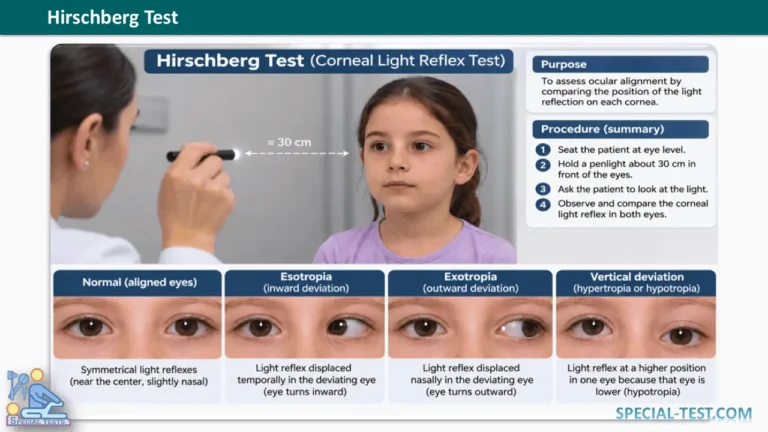
The Hirschberg test, also known as the corneal light reflex test, is a simple, noninvasive clinical examination used to evaluate ocular alignment and screen for strabismus (misalignment of the eyes). The test involves directing a light toward both eyes and comparing the position of the light reflection on each cornea.
Under normal conditions, the corneal light reflexes appear in corresponding positions in both eyes, usually near the center of each pupil or slightly toward the nose. Asymmetrical reflections may indicate an ocular deviation, including esotropia, exotropia, or vertical strabismus.
The Hirschberg eye test is particularly useful in infants, young children, and patients who cannot cooperate with conventional cover testing. Because it requires minimal patient participation and no specialized equipment beyond a penlight, it is frequently incorporated into pediatric eye examinations and routine clinical assessments.
However, the Hirschberg test is primarily a screening and approximate measurement technique. Although it can identify obvious manifest strabismus, it is less reliable for detecting small, intermittent, or latent ocular deviations. [1,2]
Purpose of the Hirschberg Test
The main purpose of the Hirschberg test is to assess whether both eyes are aligned toward the same fixation target.
Its important clinical applications include:
- Screening for strabismus: Identifying visible ocular misalignment, particularly in young children.
- Evaluating ocular alignment: Comparing the position of corneal light reflections in both eyes.
- Assessing uncooperative patients: Providing an alternative when formal cover testing is difficult.
- Differentiating true strabismus from pseudostrabismus: Helping distinguish genuine eye misalignment from an apparent deviation caused by facial anatomy.
- Estimating ocular deviation: Providing a rough assessment of the magnitude and direction of an eye turn.
- Supporting clinical follow-up: Documenting observable changes in ocular alignment over time.
The Hirschberg test is not a substitute for visual acuity assessment, ocular motility examination, or prism cover testing.
Principle of the Hirschberg Corneal Light Reflex Test
The Hirschberg test is based on the reflection of light from the anterior surface of the cornea, which acts as a convex reflecting surface.
When a patient fixates on a light source positioned directly in front of the face, a small bright reflection, known as the first Purkinje image, becomes visible on each cornea.
In normally aligned eyes, these reflections appear approximately symmetrical relative to the pupils. They may lie slightly nasal to the pupil centers because of the normal anatomical relationship between the visual and optical axes.
When one eye deviates from the fixation target, the relative position of its corneal reflection changes.
For example:
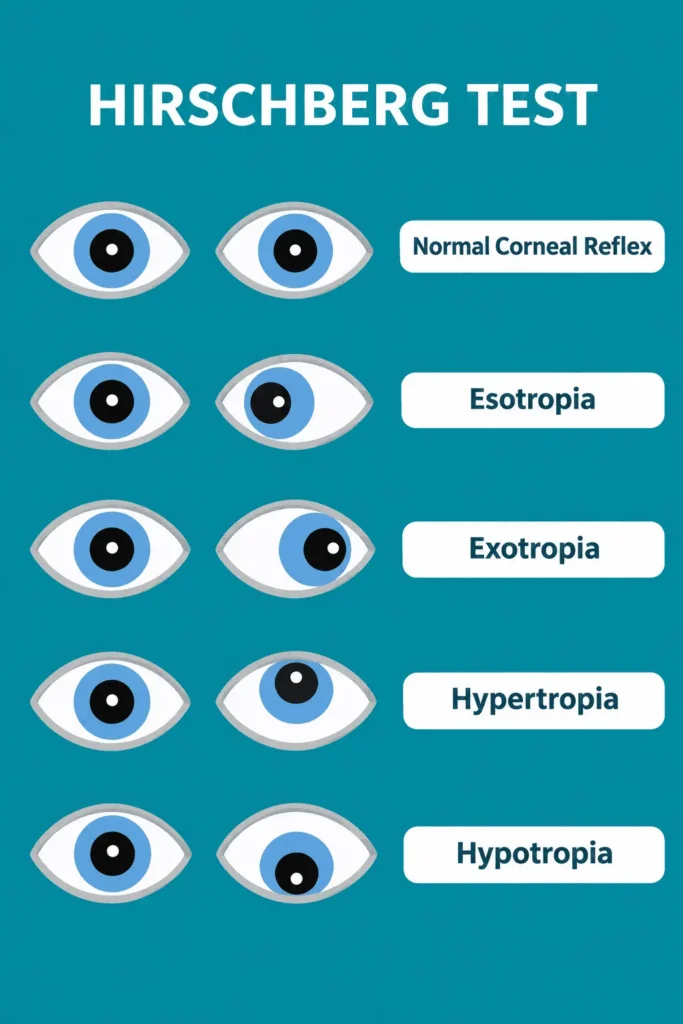
- In esotropia, the affected eye turns inward and its corneal light reflex appears displaced temporally.
- In exotropia, the affected eye turns outward and its reflex appears displaced nasally.
- In vertical strabismus, one corneal reflection may be displaced superiorly or inferiorly relative to the other.
These observations help identify the probable direction of ocular misalignment but require confirmation with additional clinical tests. [1,2]
How to Perform the Hirschberg Test
The Hirschberg test procedure is straightforward and can be performed during a routine eye examination.
Equipment Required
- A handheld penlight or another suitable fixation light
- An adequately illuminated examination room
- A cooperative fixation target, when needed for pediatric patients
Step-by-Step Hirschberg Test Procedure
Step 1: Position the patient
Ask the patient to sit comfortably facing the examiner with the head held upright and the eyes looking straight ahead. Young children may sit on a caregiver’s lap.
Step 2: Position the light source
Hold a penlight approximately 30 cm in front of the patient’s face, close to the examiner’s line of sight. The light should illuminate both eyes symmetrically.
Step 3: Encourage steady fixation
Ask the patient to look directly at the light. For infants or young children, use an engaging fixation target to maintain attention.
Step 4: Observe the corneal light reflexes
Examine the small bright reflections on the anterior surface of both corneas. Compare each reflection’s position relative to the corresponding pupil.
Step 5: Compare the reflex positions
Determine whether the reflections are symmetrical or whether one is displaced nasally, temporally, superiorly, or inferiorly relative to the other.
Step 6: Record the findings
Document the observed reflex positions, suspected direction of deviation, fixation quality, and any limitations affecting examination reliability.
If fixation is inconsistent, repeat the examination rather than interpreting a single observation as conclusive.
Hirschberg Test Interpretation: Normal and Abnormal Results
Correct interpretation depends on comparing the positions of both corneal reflections rather than judging the appearance of each eye separately.
| Hirschberg Test Finding | Possible Interpretation |
|---|---|
| Symmetrical, central or slightly nasal reflexes | Normal-appearing ocular alignment |
| Temporally displaced reflex in one eye | Esotropia (inward eye deviation) |
| Nasally displaced reflex in one eye relative to the fellow eye | Exotropia (outward eye deviation) |
| Asymmetrical vertical reflex positions | Possible vertical strabismus |
| Inconsistent or poorly visible reflexes | Inconclusive examination |
Normal Hirschberg Test
A normal Hirschberg test demonstrates symmetrical corneal light reflexes in the two eyes while the patient maintains fixation.
This supports normal ocular alignment at the moment of examination. Nevertheless, normal reflexes do not exclude intermittent strabismus, microtropia, or latent ocular deviations.
Positive Hirschberg Test
An abnormal or positive Hirschberg test demonstrates asymmetrical corneal light reflex positions that may indicate manifest ocular misalignment.
The examiner should consider the direction of displacement, fixation stability, facial anatomy, and findings from additional ocular alignment examinations before making a diagnosis.
Hirschberg Test and Angle of Strabismus
In addition to identifying obvious misalignment, the Hirschberg test can provide an approximate estimate of the angle of ocular deviation.
The magnitude of strabismus is commonly expressed in prism diopters (PD), a unit used to quantify ocular misalignment.
Traditional bedside descriptions commonly use an approximate conversion of 14 prism diopters per millimeter of corneal light reflex displacement.
However, studies using standardized photographic measurements have reported higher conversion factors, typically around 20–22 prism diopters per millimeter.
For example, Eskridge and colleagues reported a conversion factor of approximately 22 PD/mm, while Brodie reported approximately 21 PD/mm using photographic calibration. [3,4]
These estimates are not interchangeable because the conversion depends on the measurement technique and optical geometry. Individual ocular anatomy may also introduce variability.
Therefore, the Hirschberg test should not be used as the sole method for precise measurement of ocular deviation, especially when the result will influence treatment or surgical planning.
Hirschberg Test vs. Cover Test vs. Krimsky Test
Several clinical techniques evaluate ocular alignment, but they differ in their accuracy and purpose.
| Test | Main Purpose | Important Feature |
|---|---|---|
| Hirschberg test | Screen for manifest eye misalignment | Quick, noninvasive, and requires little cooperation |
| Cover–uncover test | Detect manifest strabismus | Observes refixation movements when one eye is covered |
| Alternate cover test | Reveal total ocular deviation | Helps identify both manifest and latent components |
| Prism alternate cover test | Quantify ocular deviation | More precise clinical measurement in cooperative patients |
| Krimsky test | Estimate manifest deviation with prisms | Useful when conventional cover testing cannot be performed |
Published comparative studies show that Hirschberg and Krimsky measurements are less accurate than prism and alternate cover testing for determining the angle of strabismus. [5,6]
Consequently, the Hirschberg test is most valuable as an initial assessment or when more precise methods are not feasible.
Clinical Importance of the Hirschberg Test in Children
The Hirschberg test is particularly important in pediatric ophthalmology because young children may be unable to recognize or communicate visual symptoms.
Early identification of strabismus matters because persistent ocular misalignment can be associated with amblyopia, a developmental reduction in vision commonly described as lazy eye.
The examination is also helpful in assessing pseudostrabismus, a condition in which the eyes appear crossed despite normal alignment.
Pseudostrabismus commonly occurs in children with prominent epicanthal folds or a broad, flat nasal bridge. Symmetrical corneal reflexes and a normal cover test support the absence of manifest misalignment at the time of examination.
However, children with persistent or recurrent suspected eye deviation still require appropriate clinical assessment, even if a brief corneal reflex examination appears normal. [1,2]
Accuracy and Limitations of the Hirschberg Test
Although easy to perform, the Hirschberg test has several limitations that clinicians must recognize.
1. Limited sensitivity for small deviations
Minor eye misalignment may produce subtle changes in the corneal light reflex that are difficult to identify consistently.
2. Intermittent strabismus may be missed
If the eyes happen to be aligned during examination, the test may appear normal despite a history of intermittent deviation.
3. Anatomical variations affect interpretation
Differences in corneal curvature, pupil position, and the angle between ocular axes can influence reflex position.
4. Patient cooperation influences reliability
Poor fixation, head movement, and inconsistent attention can produce misleading observations.
5. Limited measurement precision
Estimating prism diopters from corneal reflex displacement is less accurate than standardized prism cover testing.
6. The test does not assess visual function comprehensively
The Hirschberg test cannot independently determine visual acuity, refractive error, stereopsis, or the presence of amblyopia.
Research examining clinical accuracy has demonstrated meaningful variation in estimates obtained with the Hirschberg method, particularly for larger deviations. [5,6]
When Is Further Ophthalmological Evaluation Necessary?
An abnormal Hirschberg test should be interpreted in the context of the patient’s age, symptoms, and complete ocular examination.
An ophthalmology or orthoptic assessment is appropriate when a patient demonstrates persistent ocular deviation, abnormal fixation, reduced vision, or suspected binocular vision dysfunction.
Children with suspected strabismus should receive timely evaluation because early recognition can help identify conditions associated with amblyopia.
Adults who develop sudden-onset strabismus or new double vision also require prompt medical assessment. New diplopia accompanied by severe headache, neurological symptoms, or other acute abnormalities may require emergency evaluation.
Additional examinations may include visual acuity testing, cover testing, prism measurements, ocular motility assessment, cycloplegic refraction, and binocular vision evaluation.
Documentation of Hirschberg Test Findings
Accurate clinical documentation should include the patient’s age, reason for examination, fixation target, test conditions, and observed corneal reflection positions.
The examiner should record whether the reflexes were symmetrical or asymmetrical, identify the suspected direction of deviation, and note whether cooperation affected the result.
An example of appropriate documentation is:
“Hirschberg test performed in primary gaze with binocular fixation on a penlight. Corneal light reflexes symmetrical and slightly nasal to the pupil centers bilaterally. No obvious manifest ocular deviation detected during examination.”
Such a finding should not be interpreted as excluding all forms of strabismus.
Frequently Asked Questions About the Hirschberg Test
1. What is the Hirschberg test used for?
The Hirschberg test is primarily used to assess ocular alignment and screen for manifest strabismus. It helps identify possible inward, outward, or vertical deviations by comparing corneal light reflex positions.
2. How do you perform the Hirschberg test?
The examiner shines a penlight toward both eyes while the patient looks directly at it. The positions of the light reflections are compared relative to the pupils. Asymmetry may indicate ocular misalignment.
3. What is a normal Hirschberg test result?
A normal result shows symmetrical corneal light reflexes, generally near the center of each pupil or slightly nasal to the pupil centers. It suggests that the eyes are aligned during the examination.
4. Can the Hirschberg test detect strabismus in infants?
Yes. The Hirschberg test is useful in infants because it requires minimal cooperation. However, a comprehensive pediatric eye examination may still be needed to establish the diagnosis.
5. What does an abnormal Hirschberg test indicate?
An abnormal result may indicate esotropia, exotropia, or vertical strabismus. Anatomical variations and fixation difficulties can also affect the appearance of the reflections.
6. How accurate is the Hirschberg test?
The test is useful for recognizing obvious ocular misalignment but is less precise for measuring the angle of deviation. The prism alternate cover test generally provides more reliable quantitative measurements when the patient can cooperate.
7. What is the difference between the Hirschberg and Krimsky tests?
The Hirschberg test estimates ocular deviation by observing corneal light reflex positions. The Krimsky test adds prisms to neutralize the observed reflex asymmetry, allowing an estimate of deviation in prism diopters.
8. Is the Hirschberg test painful?
No. It is a noninvasive examination that requires only brief illumination of the eyes. It does not involve contact with the cornea or the use of needles.
9. Can a normal Hirschberg test rule out strabismus?
No. Small-angle, latent, or intermittent deviations may not be apparent during the examination. Additional tests are necessary when clinical suspicion remains.
Conclusion
The Hirschberg test (corneal light reflex test) is a practical and valuable screening tool for evaluating eye alignment, particularly in infants, young children, and patients who cannot cooperate with conventional ocular alignment testing.
By comparing the position of corneal light reflections, clinicians can recognize possible manifest strabismus and estimate the general direction of ocular deviation.
Nevertheless, the test has important limitations regarding accuracy, individual anatomical variation, and the detection of subtle or intermittent eye misalignment. For a definitive assessment, its findings should be interpreted alongside cover testing, visual acuity measurement, and other appropriate ophthalmological investigations.
References
- American Academy of Ophthalmology. Pediatric Eye Evaluations Preferred Practice Pattern. Available through PubMed Central (NCBI). Read full article.
- Loh AR, Chiang MF. Pediatric Vision Screening. Pediatrics in Review. 2018. Read on PubMed Central.
- Eskridge JB, Wick B, Perrigin D. The Hirschberg test: a double-masked clinical evaluation. American Journal of Optometry and Physiological Optics. 1988;65(9):745–750. PubMed PMID: 3056019.
- Brodie SE. Photographic calibration of the Hirschberg test. Investigative Ophthalmology & Visual Science. 1987;28(4):736–742. PubMed PMID: 3557878.
- The accuracy of experienced strabismologists using the Hirschberg and Krimsky tests. Ophthalmology. 1998. PubMed PMID: 9663237.
- Tirmizi IEQ, Sadiq SMAA. Is Hirschberg enough? A comparative study of corneal light reflex test and alternate prism cover test in measuring comitant horizontal strabismus. European Journal of Ophthalmology. 2025;35(6):2290–2297. PubMed PMID: 40560152.
- Tests for detecting strabismus in children aged 1 to 6 years in the community. Cochrane Database of Systematic Reviews. Read on PubMed Central.